 Medblaze
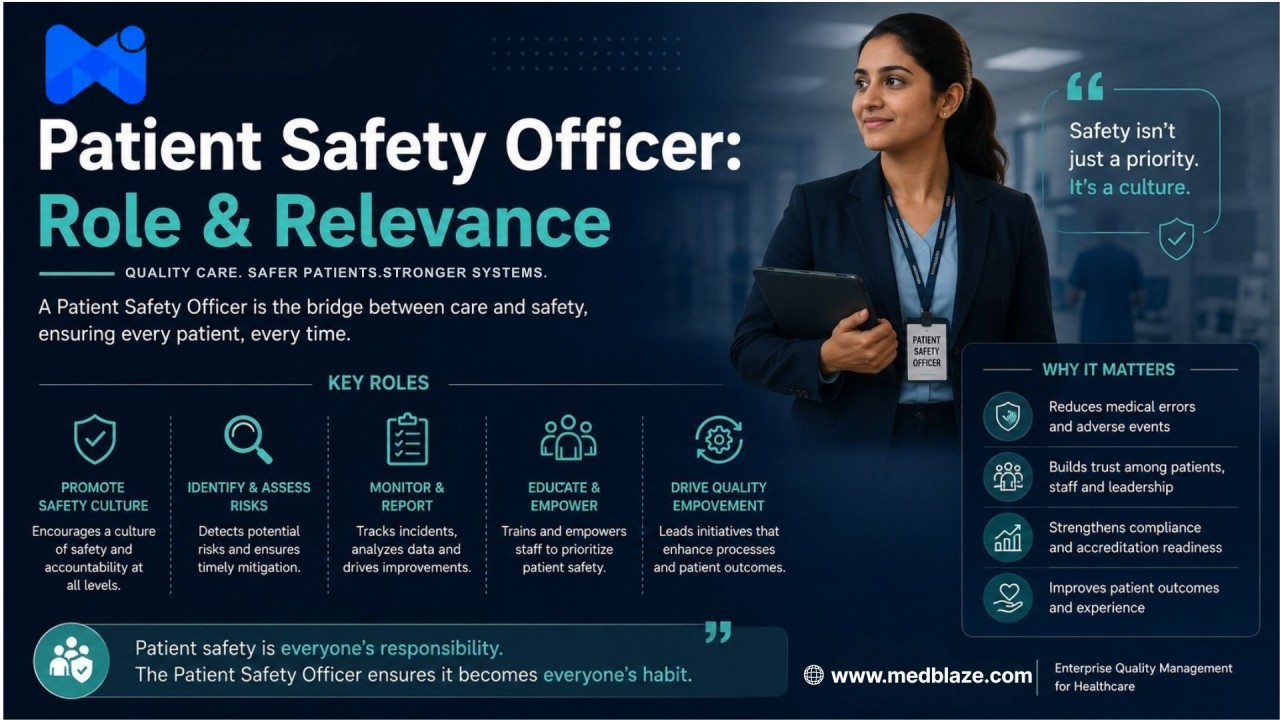
The Untold Evolution of the Patient Safety Officer Over the Last 25 Years
“The Patient Safety Officer did not simply evolve with healthcare. The role evolved because healthcare itself demanded a fundamentally different way of thinking about safety.”
The reflections shared in this article are adapted from my recent webinar on the evolution of Patient Safety Programmes and the changing role of the Patient Safety Officer. While preparing for the session, I found myself reflecting on a question that perhaps deserves greater attention than any discussion on accreditation, technology, or artificial intelligence.
Have we spent so much time discussing patient safety programmes that we overlooked the remarkable evolution of the individual responsible for leading them?
For nearly three decades, healthcare has invested billions in accreditation systems, incident reporting platforms, electronic medical records, simulation training, digital dashboards and, more recently, artificial intelligence. Yet the uncomfortable reality remains unchanged—preventable patient harm continues to be one of the leading causes of death worldwide.
This paradox forces us to ask an uncomfortable question.
If healthcare has become smarter, why hasn’t it become proportionately safer?
The answer, I believe, lies in how we define patient safety itself.
Patient safety has never been a destination. It has been a continuously evolving discipline. More importantly, every shift in patient safety philosophy has demanded a corresponding transformation in the people responsible for implementing it.
The history of modern patient safety can therefore be understood through two parallel journeys.
One is the evolution of patient safety programmes.
The other is the evolution of the Patient Safety Officer (PSO).
The two are inseparable.
The Moment That Changed Healthcare Forever
In 1999, the Institute of Medicine published what would arguably become the most influential healthcare report of modern times—To Err is Human. The report estimated that nearly 98,000 Americans died annually because of preventable medical errors, placing patient harm among the leading causes of death. More importantly, it challenged a deeply entrenched assumption: healthcare professionals were not failing because they lacked competence. They were failing because they worked within imperfect systems.
This represented a profound shift in thinking.
For generations, adverse events had been viewed through the lens of individual accountability. The instinctive response to an error was to identify the person responsible. The report argued something radically different—that competent professionals working within poorly designed systems would inevitably make mistakes.
The focus shifted from asking:
“Who made the mistake?”
to
“Why did the system allow the mistake to happen?”
That single question transformed patient safety from a disciplinary exercise into a systems science.
It also marked the birth of the modern Patient Safety Officer.
Before We Continue…
Pause for a moment and consider your own organisation.
When an adverse event occurs, what is the first question your leadership team asks?
If the answer begins with “Who?”, your organisation may still be operating with a mindset rooted in the previous century.
Era One (1999–2005)
Safety 1.0 — When Reporting Became Revolutionary
The earliest Patient Safety Officers were, in many ways, custodians of organisational memory.
Their primary responsibilities were straightforward:
Collect incident reports.
Investigate sentinel events.
Conduct Root Cause Analyses.
Maintain registers.
Present findings to safety committees.
Today, these tasks may seem administrative. In 1999, however, they represented a revolution.
Hospitals had very little visibility into the true frequency of adverse events because most incidents simply went unreported. Staff feared blame, litigation, reputational damage and disciplinary action. Errors remained hidden.
Incident reporting therefore became the first essential step toward organisational transparency.
The Patient Safety Officer emerged as the individual responsible for ensuring that harm was acknowledged rather than concealed.
Yet this era also revealed an important limitation.
Collecting reports did not automatically prevent future harm.
Many organisations proudly measured success by the number of incidents reported or investigations completed. Unfortunately, documenting harm is not the same as reducing harm.
Healthcare had taken its first step, but it had not yet begun the journey.
Food for Thought
A hospital with ten thousand incident reports is not necessarily safer than one with one thousand.
It may simply be better at documentation.
Safety begins not with reporting.
It begins with learning.
Era Two (2005–2012)
Standardisation Changed Everything
As healthcare organisations accumulated thousands of incident reports, a striking pattern emerged.
The same mistakes kept happening.
Medication errors.
Communication failures.
Wrong-site surgeries.
Patient identification failures.
The industry realised that identifying errors was insufficient. The real challenge lay in preventing predictable variation.
This period witnessed one of the greatest patient safety interventions ever introduced—the WHO Surgical Safety Checklist.
Remarkably simple, requiring only a few minutes to complete, the checklist demonstrated significant reductions in surgical complications across diverse healthcare settings. Within a few years, hospitals across more than 190 countries had adopted the approach.
For Patient Safety Officers, this represented another transformation.
Their responsibilities expanded from investigators to implementation leaders.
They now introduced clinical pathways, standard operating procedures, care bundles, compliance audits and accreditation frameworks.
The PSO had become the organisation’s compliance champion.
Hospitals around the world embraced standardisation because standardisation saves lives.
Yet another paradox soon emerged.
Completing a checklist is not the same as using it thoughtfully.
A surgical timeout performed mechanically offers little protection if the operating team has mentally disengaged.
Healthcare was becoming compliant.
Whether it was becoming safer remained an open question.
Another Question Worth Asking
How often do we celebrate 100% compliance while overlooking 0% engagement?
Policies can mandate behaviour.
They cannot create commitment.
The NHS Taught the World an Important Lesson
Few healthcare systems have invested more heavily in patient safety than the National Health Service (NHS) in England.
It built one of the world’s largest incident reporting databases. Millions of safety reports were submitted annually.
By every numerical indicator, the system appeared mature.
Yet the Mid Staffordshire and Morecambe Bay inquiries exposed tragic failures in patient care despite the abundance of policies, committees and reports.
The lesson was profound.
Reporting does not equal learning.
Policies do not equal culture.
Compliance does not equal safety.
Perhaps the most important contribution of the NHS has been its transition toward the Patient Safety Incident Response Framework (PSIRF), which encourages organisations to move beyond blame-oriented investigations toward systems learning.
Rather than asking,
“What caused this incident?”
PSIRF asks,
“What can this incident teach the entire organisation?”
That subtle difference may define the future of patient safety.
Era Three (2010–2018)
Safety Became a Cultural Challenge
By the early 2010s, healthcare had accumulated policies, checklists and accreditation standards.
Yet patients continued to experience preventable harm.
The missing ingredient was becoming increasingly obvious.
Culture.
Research consistently demonstrated that hospitals with identical policies could achieve dramatically different patient outcomes.
The difference was psychological safety.
Would a junior nurse feel empowered to question a senior consultant?
Would a resident report a near miss without fear?
Would leadership welcome uncomfortable truths?
Patient safety had entered its cultural era.
The Patient Safety Officer changed once again.
No longer confined to incident investigations, the PSO now became an organisational influencer.
Leadership walk rounds.
Safety culture surveys.
Just Culture implementation.
Crew Resource Management.
TeamSTEPPS.
Speaking-up programmes.
These became integral responsibilities.
The PSO had moved from the records room into the boardroom.
Closing Reflection
If the first decade of patient safety taught us to report errors, and the second taught us to standardise care, the third taught us something even more fundamental.
People do not report what they are afraid to discuss.
Culture is not another component of patient safety.
Culture is the environment in which every other safety intervention either succeeds—or quietly fails.
In Part 2, we will explore how healthcare moved beyond culture into systems thinking, organisational learning, artificial intelligence, predictive safety, and why the Patient Safety Officer of 2030 will bear little resemblance to the role that emerged in 1999.