 Medblaze
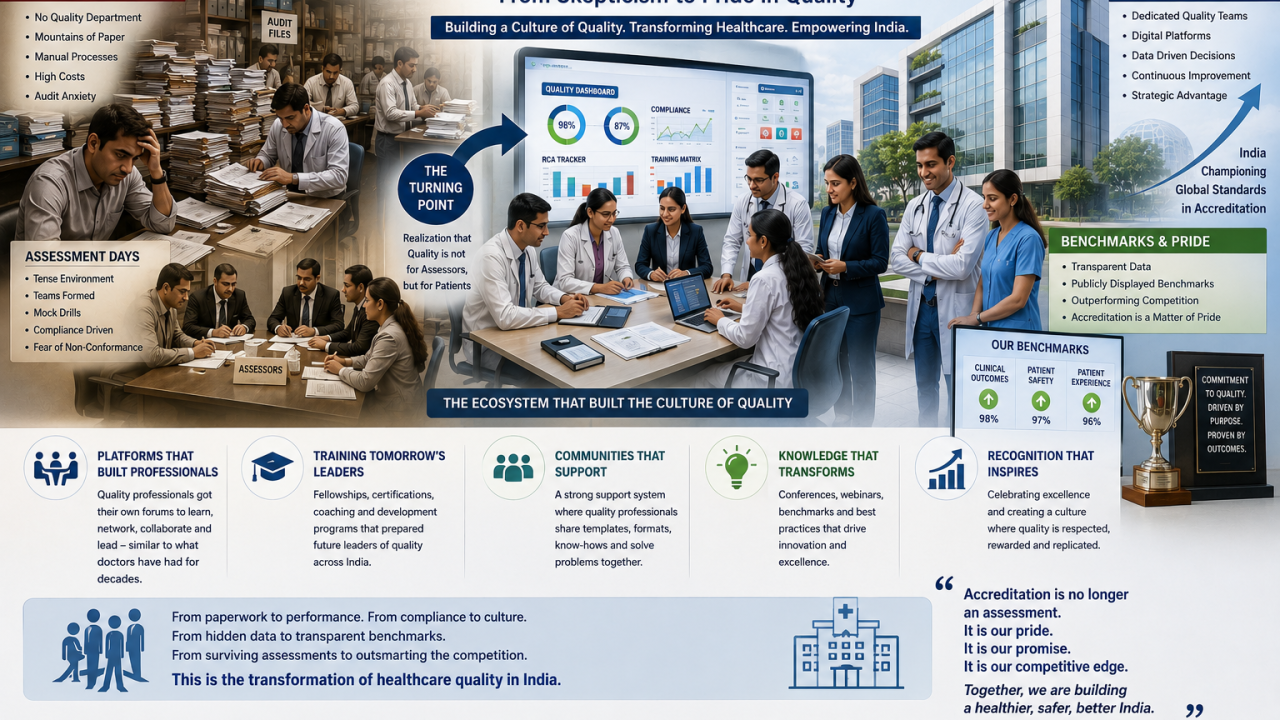
There was a time when I was an accreditation skeptic.
Not because I did not believe in quality, but because I struggled to see how truckloads of paper, endless documentation, and months of preparation translated into better patient care.
In my early professional years, I was working on quality improvement long before many hospitals even had a formal Quality Department. Those were the days when accreditation preparation meant printing mountains of policies, forms, registers, reports, and evidence files. Paper became one of the largest indirect expenses in some hospitals. Entire rooms were converted into document storage facilities. Teams worked late into the night compiling files that would often be opened only during assessments.
I vividly remember the atmosphere leading up to accreditation visits.
Special teams were formed. Departments rehearsed. Mock drills were conducted repeatedly. The days of assessment were filled with anxiety. Every employee seemed to be on edge. Success was measured by surviving the assessment rather than sustaining the improvement.
As I later became an assessor myself, I gained a different perspective.
I witnessed extraordinary organizations that genuinely embraced quality. But I also saw systems that were engineered to achieve compliance “hook or crook.” Processes occasionally existed more for assessors than for patients. Documentation sometimes overshadowed outcomes. Accreditation, at times, appeared to be a destination rather than a journey.
Yet something remarkable happened over the years.
Healthcare quality in India evolved.
Today, quality is no longer a side responsibility assigned to a few enthusiastic individuals. It has become a strategic function. Hospitals have invested in dedicated quality teams led by trained professionals who understand patient safety, clinical governance, operational excellence, risk management, and performance improvement.
Accreditation is no longer merely about passing an assessment.
It has become a source of organizational pride.
Hospitals that once hesitated to reveal performance data now proudly display their benchmarks. Quality indicators that were once guarded secrets are discussed openly at conferences and benchmarking forums. Healthcare organizations increasingly compete not on who can hide their weaknesses but on who can demonstrate measurable excellence.
The conversation has shifted from compliance to performance.
From documentation to outcomes. From inspection to improvement.
One of the most significant contributors to this transformation has been the creation of a vibrant quality ecosystem in India. Organizations such as the Association of Healthcare Providers – AHPI (India) and CAHO – Consortium of Accredited Healthcare Organizations deserve immense appreciation for building a culture of quality that extends far beyond accreditation standards.
They created something our profession desperately needed, a community.
For decades, clinicians had professional associations and forums that fostered learning, networking, recognition, and professional pride.
Pediatricians had their forums. Physicians had theirs. Surgeons had theirs.
Quality professionals had very few. AHPI and CAHO helped change that.
Through conferences, fellowships, certifications, mentoring programs, quality circles, benchmarking initiatives, and leadership platforms, they created a generation of Quality Management Professionals (QMPs) who now lead transformation across healthcare organizations in India and beyond. Many of today’s quality leaders were nurtured through these initiatives.
Equally important are communities such as Centre for Patient Safety & Quality CPSQ and other professional networks that have become invaluable support systems for quality teams. These communities are often the first line of assistance when someone needs a template, a policy format, an implementation idea, benchmarking data, or simply guidance from peers who have faced similar challenges.
The spirit of collaboration within the quality fraternity remains one of its greatest strengths.
No discussion on World Accreditation Day would be complete without recognizing the transformational role played by National Accreditation Board for Hospitals & Healthcare (NABH).
NABH democratized accreditation in India. It created pathways not only for large corporate hospitals but also for small healthcare facilities, specialty centers, day-care facilities, and emerging healthcare organizations. It continuously evolved its standards to address contemporary healthcare challenges while encouraging innovation, patient safety, and operational excellence.
Today, NABH is setting new benchmarks through initiatives such as digital health integration, progressive accreditation frameworks, and advanced recognition programs like NABH Apex that encourage organizations to move beyond compliance toward excellence.
India is no longer merely participating in the global accreditation movement.India is helping shape it.
And behind this remarkable journey stand countless individuals who dedicated their careers to advancing quality.
Today, on behalf of Medblaze and the broader healthcare community, I would like to recognize and thank the pioneers who helped propel this movement:
Dr. Girdhar Gyani. Dr. Alexander Thomas Dr. Lallu Joseph. Avinash Pandey Sohan S. Poojari . Dr. Umashankar Raj Urs Dr.Shweta Prabhakar Dr Shashank Devapur Payal Thakker Dr. Rahul Rao AKASH KHADE Dr Sweta Saket Bandal Kichu S Medicuality Healthcare Services Biniam Yohannes Wotango Dr.Neesha Ajit Nair Dr Jeet Patwari Dheeraj Khatore Thomas Mathew Dr Pramod David Jacob Thousands of NABH assessors. NABH consultants.Digital Mitras.Quality leaders.Patient safety champions.Hospital administrators.Nurses.Clinicians.
And the countless unsung heroes who spent years building systems that make healthcare safer, better, and more accountable.
The healthcare quality movement in India was not built overnight.
It was built policy by policy. Audit by audit. Indicator by indicator. Hospital by hospital. And person by person.
As we celebrate World Accreditation Day, let us remember that accreditation is not about certificates hanging on walls.
It is about creating systems that patients can trust.
It is about making excellence repeatable.
It is about transforming quality from a department into a culture.
And when quality becomes culture, accreditation ceases to be an event. It becomes a way of life.
To every quality professional who has been part of this journey, today, we celebrate you.