 Medblaze

Most hospitals are not short of quality data. They are short of the connections that turn it into a decision.
It is 9:30 on a Monday morning, and the Quality Manager is preparing for the monthly quality review meeting.
She has done her homework. There are Excel sheets for incidents, patient complaints, infection control indicators, audit findings, mortality and morbidity reviews, quality indicators, patient satisfaction scores, accreditation observations and corrective action plans. In fact, there is no shortage of data.
But as the meeting begins, the Medical Director asks a simple question: “What are the three most important quality and patient safety issues we need to worry about right now?” She pauses.
She has the numbers. But she struggles to tell the story behind the numbers.
She can show that 47 incidents were reported last month. She can present the percentage of patients satisfied with services. She can show audit compliance at 82% and perhaps explain that 14 corrective actions are still open. But connecting these individual numbers to identify a pattern, a risk, a root cause or a strategic priority requires considerable manual effort.
The problem is not that the hospital does not have data. The problem is that the data has not become intelligence.
The data-rich, insight-poor hospital
Modern hospitals generate enormous amounts of information every single day. Every patient interaction, clinical process, audit, incident, complaint, feedback response and operational activity creates data.
Quality teams, in particular, are becoming increasingly data-driven. They collect information on clinical outcomes, patient safety incidents, infection rates, medication errors, falls, hospital-acquired infections, mortality indicators, patient experience, audit compliance, risk assessments, corrective and preventive actions and hundreds of other parameters.
Yet in many hospitals, this information lives in separate places. One department maintains an Excel tracker for audits. Another maintains a spreadsheet for incidents. Patient feedback sits in a separate system. Risk registers may be maintained independently. Accreditation documents are stored in folders. Quality indicators are collated manually every month. Corrective actions are tracked through emails and spreadsheets.
Each dataset may be useful on its own. But quality and patient safety do not happen in silos.
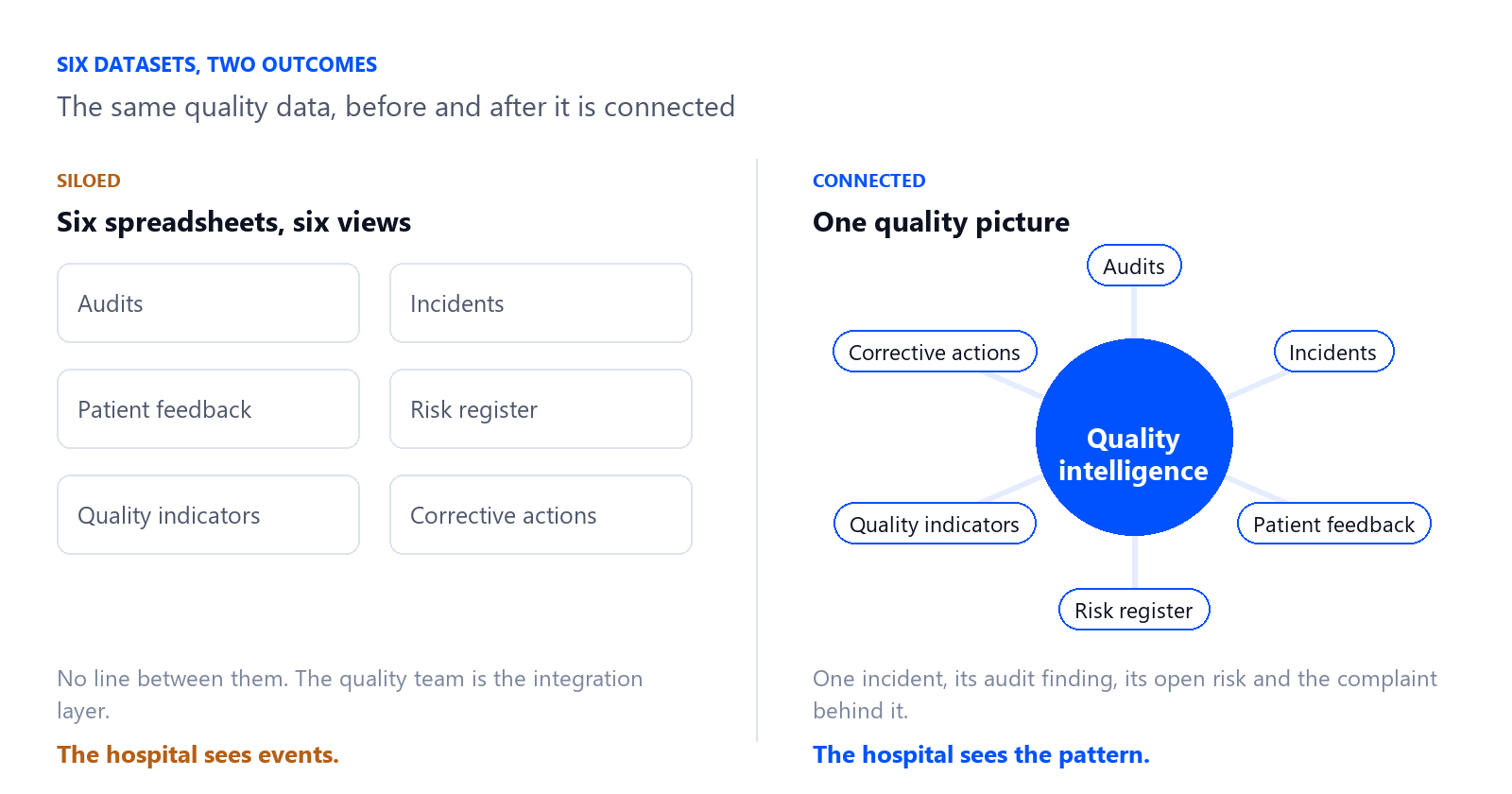
An incident may be connected to a gap identified during an audit. That audit finding may be associated with an unresolved risk. The same issue may be appearing repeatedly in patient complaints. A particular department may show declining patient experience scores at the same time.
When these pieces of information remain disconnected, the hospital sees individual events. It does not see the pattern. And without seeing the pattern, it becomes difficult to move from reactive quality management to proactive improvement.
Data is not intelligence
There is an important distinction between data, information and intelligence.
- Data tells us what happened.
- Information helps us understand what it means.
- Intelligence helps us determine what we should do next.
Consider a hospital where medication-related incidents have increased over three consecutive months. A spreadsheet can show the monthly numbers. A dashboard can show the trend.
But true quality intelligence goes further. It should help the quality team ask: where are these incidents occurring? Which medications are involved? At what stage of the medication-use process are they occurring? Is there a correlation with staffing patterns, workload, specific units or particular process failures? Were similar risks identified through audits? Have corrective actions from previous incidents actually been implemented? Are patient complaints pointing towards the same underlying problem?
Now the data is beginning to tell a story. And that story can influence a decision. That is the difference between reporting and intelligence.
The hidden cost of siloed data
One of the biggest barriers to achieving this is interoperability.
Hospitals often operate multiple applications for different functions. The Hospital Information System may contain clinical and operational information. Laboratory and radiology systems manage diagnostic data. HR systems contain workforce information. Patient feedback platforms capture experience data. Quality teams may use spreadsheets or standalone applications for audits, incidents, risks and improvement projects.
When these systems cannot communicate effectively, information becomes fragmented. Quality teams then become the bridge between systems. They download reports, copy information into Excel, reconcile different formats, remove duplicates, create pivot tables, prepare charts and manually interpret trends before every review meeting.
This is not just inefficient. It creates a fundamental limitation: human beings are being asked to perform the work that connected systems should be doing.
More importantly, valuable relationships between datasets remain invisible. A hospital may have thousands of data points but still lack a unified view of its quality and safety performance.
The result is what many organisations experience today: more data, more reports and more meetings, but not necessarily better decisions.
Interoperability is no longer a technology conversation
Interoperability is often discussed as an IT issue. For quality and patient safety, it is much more than that.
An interoperable ecosystem allows information generated across different systems to flow together so that it can be understood in context.
Imagine an incident management system that does not simply record an incident, but can connect it with the relevant department, risk register, audit findings, corrective actions and trends over time.
Imagine patient feedback that can be analysed alongside operational and quality indicators to identify recurring experience problems.
Imagine an audit finding that automatically becomes part of a corrective action workflow, with ownership, timelines, escalation and closure tracked digitally.
Imagine a quality dashboard where leadership does not merely see 82% compliance, but can drill down to understand where the gaps are, why they exist, how long they have remained unresolved and what risks they represent.
That is when technology starts creating intelligence rather than merely digitising paperwork.
From accreditation compliance to continuous improvement
Accreditation remains an important driver of quality in healthcare. Standards, audits, evidence and compliance frameworks provide hospitals with a structured approach to improving care.
But quality management should not become a periodic exercise of preparing evidence for an assessment. The real opportunity is to use accreditation requirements as a foundation for continuous quality improvement.
A modern Quality Management System can bring together audits, incidents, risks, patient feedback, quality indicators, corrective and preventive actions and improvement initiatives within a connected framework.
Instead of asking, “Are we compliant?”, leadership can begin asking more meaningful questions:
- Where are our highest risks?
- Which problems are recurring?
- Which corrective actions are not delivering results?
- Which departments are improving and which are deteriorating?
- What is affecting patient experience?
- Where should we focus our improvement resources?
These are strategic questions. And answering them requires more than a collection of spreadsheets.
The Quality Manager of tomorrow
The role of the Quality Manager is changing.
The future quality leader cannot remain only the custodian of accreditation documents, audit reports and compliance trackers. The Quality Manager needs to become a strategic partner to hospital leadership, someone who can translate quality data into insights, insights into priorities and priorities into measurable improvement.
Technology can play an important role in enabling this transition. A well-designed Quality Management System should reduce the administrative burden of collecting, consolidating and reporting data. More importantly, it should help connect information across quality functions and turn it into actionable intelligence.
Instead of spending days preparing the monthly quality review, the Quality Manager should be able to walk into the meeting with a clear picture of what is happening across the organisation. Not just what happened last month, but what is changing, why it matters and where leadership needs to act.
From dashboards to decisions
There is also a caution worth remembering. Simply replacing Excel with colourful dashboards does not create intelligence. A dashboard can still be a collection of numbers.
The real value lies in the ability to identify trends, relationships, exceptions and risks, and then connect those insights to action.
The ultimate test of a quality technology platform should not be “how many reports can it generate?” It should be “how many better decisions can it help the hospital make?”
Because the purpose of quality data is not to produce more reports. It is to make care safer, processes more reliable, experiences better and improvement more sustainable.
The next competitive advantage in healthcare
Healthcare is entering an era where hospitals will generate more data than ever before. Artificial intelligence, digital health, connected medical devices, electronic records and increasingly sophisticated hospital systems will continue to accelerate this trend.
But having more data will not automatically make hospitals smarter. The organisations that create an advantage will be those that can connect their data, understand it and act on it faster.
For hospital leaders, the question is therefore no longer simply whether their hospital is digital. The more important question is whether its digital ecosystem is connected, intelligent and capable of driving action.
Because a hospital can have thousands of spreadsheets, hundreds of reports and millions of data points, and still miss the most important signal hidden inside them.
Your hospital has data. But does it have intelligence? And more importantly: does that intelligence reach the people who need to make the next decision?
See how Medblaze Infini connects quality data into one picture →