 Medblaze
A hospital does not become resilient when a crisis arrives. It becomes resilient because of what it did long before the crisis arrived.
A power failure. A cyberattack. A critical drug shortage. A sudden outbreak. A medical device failure. A fire. A staffing crisis. A patient safety event that attracts public attention. A breakdown in a critical service. A regulatory finding that exposes a deeper systemic weakness.
These events may appear very different. But they have one thing in common: they rarely remain confined to where they started.
A disruption in the pharmacy can affect clinical care. A staffing shortage can affect patient experience and safety. An IT outage can affect everything from registration to medication administration. A supply-chain disruption can force clinicians to change established clinical practices. A serious incident can quickly become a reputational and regulatory crisis.
For hospitals, therefore, crisis preparedness cannot sit inside one department or inside a document called the “disaster management plan”. It has to become part of the way the organisation operates.
The crisis rarely begins as a crisis
Most crises begin quietly.
A medication near miss occurs. A critical supplier misses a delivery. A staff member reports an unsafe condition. A piece of equipment repeatedly fails. An infection-control observation is made. A department starts relying on workarounds. An incident is reported but the underlying cause is never addressed. A corrective action remains open for months. A recurring complaint is treated as an isolated complaint.
Individually, these may appear to be operational issues. Collectively, they can be early warning signals.
The challenge for hospital leaders is not simply to respond when the event becomes serious. It is to recognise the signals that indicate something is beginning to deteriorate, and to act while there is still time. That is the difference between crisis response and crisis readiness.
Look beyond the obvious risks
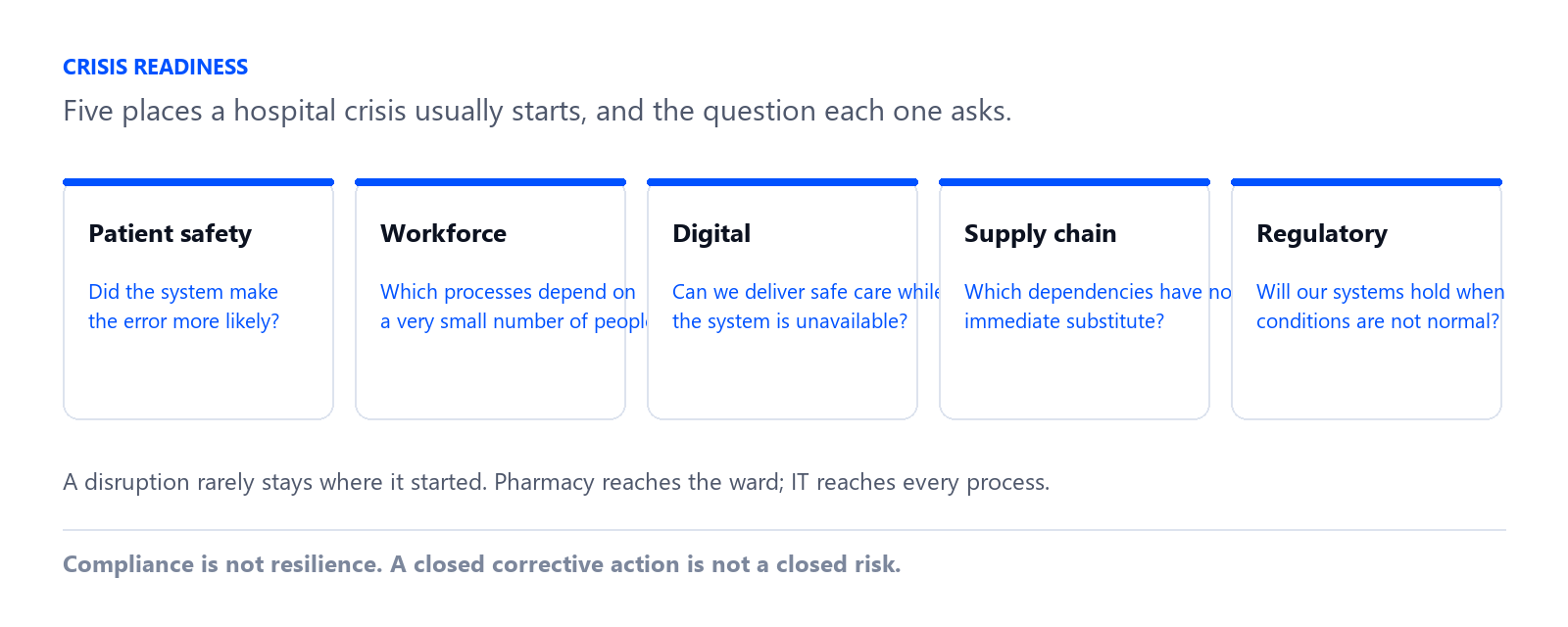
Hospitals have traditionally approached preparedness through defined emergency scenarios: fire, mass casualty incidents, natural disasters, epidemics and other major events. Those remain important. But the modern hospital faces a much broader risk landscape.
1. Patient safety risks
A single serious adverse event can expose weaknesses across multiple processes. Was the event caused by an individual error, or did the system make the error more likely? Were policies available and current? Was staff competency adequate? Were previous similar incidents reported? Had corrective actions from earlier incidents actually worked?
The organisations that learn from near misses and low-level incidents are often better positioned to prevent a high-severity event. Every incident should be viewed not only as an event to close, but as intelligence about the system.
2. Workforce and competency risks
Hospitals depend on people more than almost any other complex organisation. Staff shortages, burnout, turnover, inexperienced teams, skill gaps and inadequate staffing during peak periods can create vulnerabilities long before they become visible in patient outcomes.
A crisis-ready hospital therefore needs to know where its critical competency gaps are, which processes depend on a small number of people, what happens when experienced staff are unavailable, and whether it is continuously validating competency rather than simply completing annual training.
Preparedness is not just having enough people. It is having the right capability available when it matters.
3. Digital and technology risks
Healthcare has become increasingly dependent on technology: electronic medical records, laboratory systems, radiology, pharmacy systems, clinical communication, biomedical devices, patient portals and revenue-cycle systems.
When technology works, it is almost invisible. When it stops working, the hospital quickly discovers how dependent it has become on it.
A crisis-ready organisation needs more than a disaster recovery plan. It needs to understand clinical dependencies, downtime processes, alternative workflows and the risks created when interconnected systems fail. The question is not simply whether IT can restore the system. It is whether the hospital can continue to deliver safe care while the system is unavailable.
4. Supply-chain and infrastructure risks
Hospitals cannot provide care without medicines, consumables, blood, oxygen, equipment, utilities and critical services. The resilience question is therefore bigger than inventory.
What are the hospital’s critical dependencies? Which supplies have no immediate substitute? Which services have a single point of failure? What happens if a vendor suddenly becomes unavailable? How quickly can an alternative be activated?
Resilience comes from understanding these dependencies before they are tested.
5. Regulatory and accreditation risks
A hospital may pass an assessment and still remain vulnerable. Compliance is not the same as resilience.
A policy may exist, but is it followed? An audit may have been completed, but were the findings converted into sustained improvement? A corrective action may have been marked closed, but did the risk actually disappear?
A crisis-ready quality function therefore needs to move beyond “are we compliant?” It needs to ask how confident the organisation is that its systems will perform when conditions are not normal.
The hidden vulnerability: disconnected information
Perhaps one of the biggest challenges hospitals face is not the absence of data. It is the absence of connected intelligence.
Incident reports may sit in one system. Complaints in another. Audits in spreadsheets. Risk registers in documents. Corrective actions in emails. Training records somewhere else. Patient-safety indicators on dashboards. Accreditation evidence in folders.
Each department may have information. But leadership may struggle to see the connections.
A medication incident, a staffing gap, a competency issue and an audit finding may actually be different symptoms of the same underlying risk. If those signals remain disconnected, the organisation reacts to events individually. If they are connected, the organisation can identify patterns. And patterns are where prevention begins.
From incident management to organisational learning
A mature hospital does not ask only what happened. It asks why it happened. Then: has this happened before? Where else could it happen? What controls failed? Who owns the corrective action? How will we know the action worked?
And perhaps most importantly: what are we changing so that the same risk does not appear somewhere else?
This is where quality management moves from documentation to organisational intelligence. The goal is not to create more reports. The goal is to create better decisions.
Crisis readiness is a continuous cycle
Crisis preparedness should not be an annual exercise. It should be a continuous cycle.
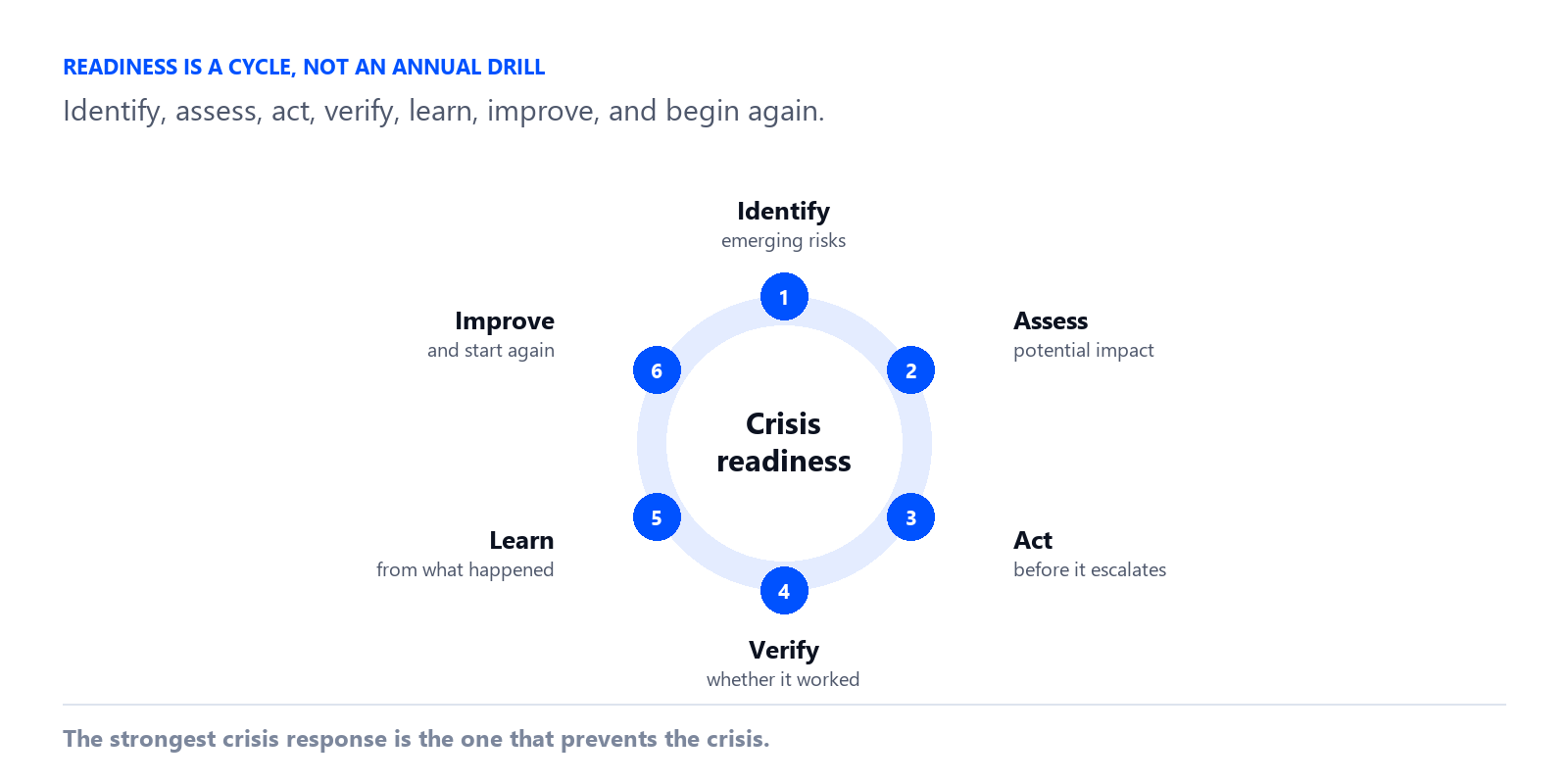
Identify emerging risks. Assess their potential impact. Act before they escalate. Verify whether the intervention worked. Learn from incidents, near misses, audits and frontline observations. Improve the system, and begin the cycle again.
This creates an organisation that is continuously becoming more resilient, because the strongest crisis response is often the one that prevents the crisis from happening in the first place.
Where a quality management system can make a difference
A modern Quality Management System can become much more than a platform for accreditation documentation. It can become part of the hospital’s organisational resilience infrastructure.
A connected QMS can bring together the signals that are otherwise scattered across the organisation: incidents, near misses, complaints, audits, risks, CAPA, policies, training, indicators and accreditation.
When these elements are connected, the hospital can move from fragmented quality activities to a more complete view of organisational risk. For example, a QMS can help leadership identify that:
- the same type of incident is occurring repeatedly across departments;
- corrective actions are being delayed or repeatedly extended;
- a particular process is generating recurring audit findings;
- competency gaps are associated with specific incidents;
- complaints are pointing towards a systemic service issue;
- a high-risk process has multiple unresolved observations;
- risks are increasing even though individual incidents appear manageable.
That changes the role of quality. Quality is no longer simply reporting what happened. It becomes a mechanism for understanding what could happen next.
From QMS to a crisis-ready hospital
A truly effective QMS should help an organisation answer five questions at any moment.
- What are our biggest risks? Not just the risks documented in a register, but the risks emerging from real operational data.
- What is changing? Are incidents increasing? Are complaints changing? Are audit findings recurring? Are corrective actions ageing?
- What requires leadership attention now? Not every issue needs the same level of escalation. A QMS should help distinguish routine operational issues from emerging enterprise-level risks.
- Are our actions actually working? Closing a CAPA is not the same as reducing risk. The organisation needs evidence that the intervention produced the intended improvement.
- What have we learned? Every incident, audit, complaint, risk and improvement initiative should contribute to organisational learning.
The ultimate test of a QMS
The real value of a QMS is not how many forms it digitises. It is not how many audit reports it generates. It is not even how quickly an organisation can produce evidence during an accreditation assessment.
The real test is what happens when the unexpected happens.
Can leaders see what is happening? Can they identify emerging risks? Can teams respond quickly? Can responsibilities be activated? Can previous lessons be retrieved? Can corrective actions be tracked? Can leadership see whether the organisation is becoming safer, or simply generating more data?
A crisis-ready hospital is not one that believes it can predict every crisis. It is one that has built the capability to sense, respond, learn and adapt when circumstances change.
And that capability cannot be created overnight. It is built every day, in every incident reported, every risk assessed, every audit finding acted upon, every corrective action verified, every lesson shared and every improvement sustained.
Resilience is not what a hospital does when a crisis arrives. Resilience is what the hospital has built before it arrives.
See how Medblaze Infini connects the signals before they become a crisis →