 Medblaze
Why hospitals must move beyond compliance documentation and rediscover the real purpose of a checklist.
In healthcare quality management, few tools are as widely used, frequently audited and routinely misunderstood as the humble checklist.
Walk into almost any hospital today, and you will find checklists for everything: patient identification, medication administration, surgical safety, infection prevention, equipment maintenance, biomedical waste management, medical records, nursing procedures and accreditation compliance. They are printed, laminated, displayed on walls, incorporated into registers and increasingly embedded in hospital information systems.
Yet an uncomfortable question deserves our attention: if hospitals are using so many checklists, why do the same errors, omissions and safety incidents continue to occur?
Why does a completed checklist sometimes coexist with an incomplete clinical assessment? Why do we find all the boxes ticked when a process has clearly failed? And why has a tool originally intended to prevent human error become, in many organisations, another document to be completed before an auditor arrives?
The answer may lie not in the checklist itself, but in how we have come to understand and use it.
As healthcare quality professionals, we need to revisit the purpose of checklists, understand their evolution, examine why they lose their effectiveness and explore how they can be transformed into meaningful instruments of quality improvement.
The origin story: when even the best pilot needed a checklist
The modern aviation checklist is often associated with a defining moment in 1935, when Boeing’s Model 299 prototype, which would eventually become the B-17 Flying Fortress, crashed during a demonstration flight. The aircraft was considerably more complex than earlier planes, and the investigation identified a failure to release a control lock before take-off.
The incident highlighted an important limitation of human performance: experience and expertise do not eliminate the possibility of forgetting a critical step.
Rather than simply demanding more training or expecting pilots to remember everything, Boeing’s engineers and test pilots developed checklists to support the operation of the increasingly complex aircraft. The approach helped make it possible for pilots to manage tasks that could no longer be performed reliably through memory alone.
The checklist was not an admission that pilots lacked knowledge. It was an acknowledgement that even highly trained professionals are vulnerable to omissions when they operate in complex, high-pressure environments.
That distinction is particularly relevant to healthcare. A surgeon may know the principles of safe surgery. A nurse may understand medication administration protocols. An infection prevention professional may be thoroughly familiar with aseptic precautions. But knowing what to do and reliably doing it, every time, are two different challenges.
The checklist emerged as a practical response to that gap. It became a way of supporting expertise, not replacing it.
Healthcare’s B-17 moment: the emergence of checklists in patient safety
For much of modern medicine, the dominant response to errors was to focus on individual knowledge, competence and professional responsibility. Training, experience and clinical judgement were understandably regarded as essential to good care.
However, as healthcare became more technologically sophisticated, the number of tasks, decisions, handovers and interdependent processes involved in patient care increased substantially. The challenge was no longer simply whether clinicians knew the correct action. It was whether healthcare teams could reliably execute the necessary actions amid interruptions, competing priorities, emergencies and organisational complexity.
One of the influential early healthcare applications of this approach came from Dr Peter Pronovost, a critical care physician at Johns Hopkins. In 2001, Pronovost developed a simple checklist to improve adherence to essential infection prevention practices during central venous catheter insertion. The checklist addressed five basic measures, including hand hygiene, skin antisepsis, sterile draping, appropriate sterile barriers and dressing the catheter insertion site.
These were not new discoveries. They were established practices that clinicians were already expected to know. Yet observing actual practice revealed a significant reliability problem: essential steps were sometimes being missed.
Pronovost’s work demonstrated how a checklist, combined with observation, accountability and changes in team culture, could help close the gap between established knowledge and routine practice. The subsequent Michigan Keystone initiative extended this work across hospitals, demonstrating the potential of a coordinated, system-level approach to reducing central line-associated bloodstream infections.
This was an important lesson for healthcare quality management. The objective was not to create another form. It was to make evidence-based practices happen reliably at the point of care.
From intensive care to the operating theatre
Another major milestone came through the work of surgeon and public health researcher Dr Atul Gawande.
Working with the World Health Organization’s Safe Surgery Saves Lives initiative, Gawande and an international team developed the WHO Surgical Safety Checklist. Introduced in 2008, the checklist was designed to improve communication, coordination and adherence to essential safety practices before anaesthesia, before incision and before the patient leaves the operating room.
The checklist was evaluated in eight hospitals across different countries and healthcare settings. The study reported reductions in major surgical complications and deaths following implementation. Its influence helped establish checklists as an important component of modern surgical safety practice.
The early healthcare adopters were not merely copying aviation procedures. They were adapting the underlying principle: when a process is complex and the consequences of omission are serious, a carefully designed checklist can support reliable execution.
Pronovost’s ICU work and the WHO Surgical Safety Checklist helped bring this principle into mainstream patient safety discussions. Gawande’s 2009 book, The Checklist Manifesto, subsequently brought wider attention to the role of checklists in managing complexity across professional settings.
Why creating checklists is no longer optional
Healthcare organisations today operate within increasingly demanding environments. Accreditation requirements, patient safety expectations, clinical protocols, statutory obligations and internal quality standards require hospitals to demonstrate that critical processes are consistently performed and monitored.
A checklist can help translate these requirements into observable actions at the point where care is delivered. Consider a few examples.
- A patient identification checklist can help ensure that the correct patient is identified before medication administration, specimen collection or a procedure.
- A surgical safety checklist can support team communication and verification of critical safety information before an operation proceeds.
- An infection prevention checklist can help monitor adherence to essential precautions and identify gaps in practice.
- A discharge checklist can help ensure that medication reconciliation, patient education, follow-up arrangements and relevant documentation are addressed before the patient leaves the hospital.
- A medical records checklist can help identify missing documentation that may affect continuity of care, clinical decision-making or compliance.
In each case, the checklist helps convert a broad expectation into a structured process that can be observed, verified and improved.
But there is an important qualification. Creating a checklist is not the same as creating a safe process.
A hospital may have a checklist for every critical activity and still experience failures if the checklist is poorly designed, inconsistently used, disconnected from clinical workflows or treated as a documentation exercise. The real requirement is not simply to have checklists. It is to establish reliable processes and use checklists as one of the tools that support them.
How did the checklist become a ticklist?
Somewhere between the original patient safety movement and the routine demands of hospital administration, the checklist began to change its character. A tool intended to support critical thinking and reliable execution gradually became, in many settings, a mechanism for demonstrating completion.
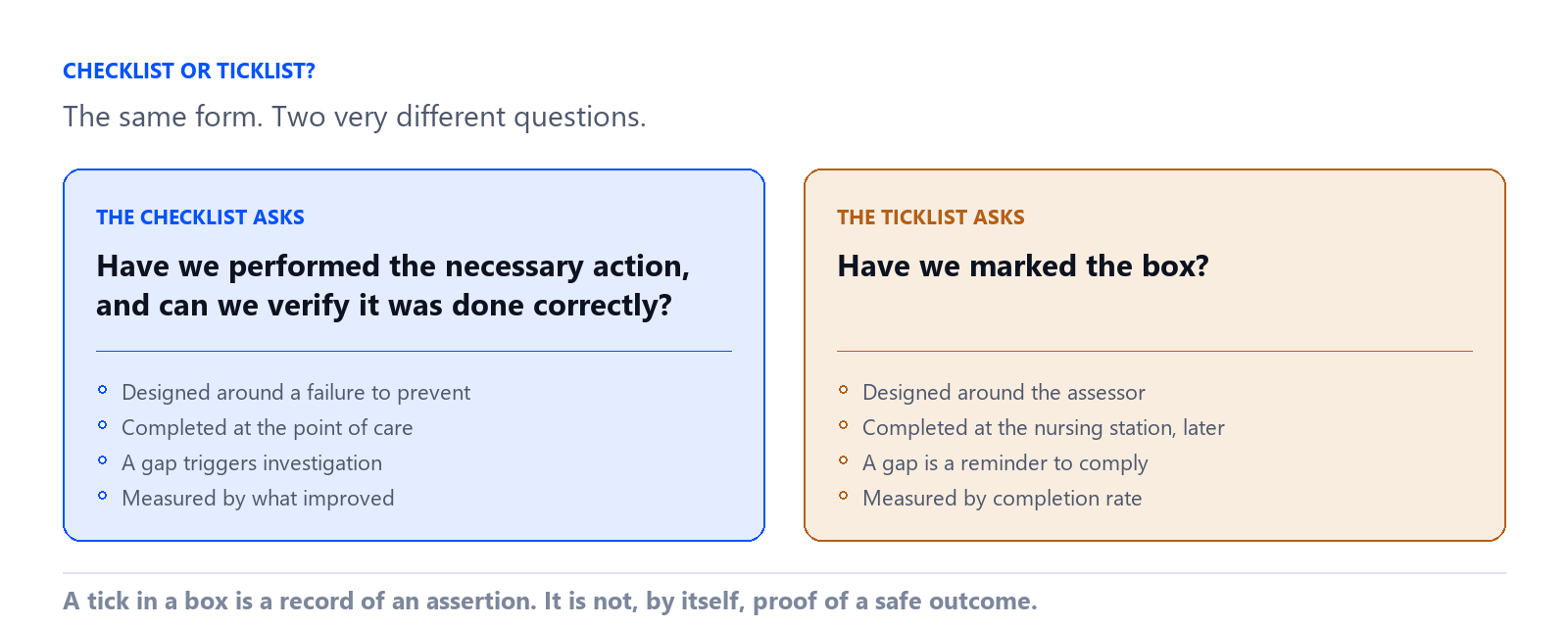
The distinction may appear subtle, but its consequences are significant. A checklist asks: have we performed the necessary action, and can we verify that it was done correctly? A ticklist asks: have we marked the box?
This transformation often occurs through several familiar organisational behaviours.
First, checklists are created primarily to satisfy accreditation requirements. The organisation starts with the question, “what document will the assessor expect?” rather than, “what failure are we trying to prevent?”
Second, the checklist becomes excessively long. Every department adds another item, every audit observation generates another checkbox, and every new policy creates another field. Eventually, the document becomes so cumbersome that users focus on completing it rather than understanding its purpose.
Third, completion becomes the performance measure. Managers celebrate 100% checklist compliance without establishing whether the underlying process has improved. The completed form becomes evidence of success, even when the actual outcome remains unchanged.
Fourth, checklists become detached from the workflow. Staff may complete them retrospectively, at a nursing station or at the end of a shift, rather than at the point where the action needs to occur.
Finally, the organisational culture discourages meaningful challenge. A junior team member may notice that a step has not been completed but hesitate to question a senior colleague. The form may be complete, but the safety function it was meant to serve has disappeared.
The result is a dangerous illusion of reliability. A completed checklist can create confidence without providing assurance. This is particularly concerning when checklist completion is used as a proxy for quality, safety or compliance without validating whether the required actions actually occurred.
A tick in a box is a record of an assertion. It is not, by itself, proof of a safe outcome.
How to use checklists effectively: from compliance to improvement
A checklist should begin with a clearly defined problem, not with a blank document.
Before developing one, a quality manager should ask: what are we trying to prevent? What is the failure mode? At which point in the workflow could the failure occur? Which actions are essential to prevent it? And how will we know whether the checklist is making a difference?
These questions help ensure that the checklist is designed around a real operational or clinical risk rather than a generic expectation.
1. Start with the risk, not the regulation
Accreditation standards can provide an important starting point, but they should not be the sole basis for checklist development.
A standard may require hospitals to establish a process for safe medication administration. The checklist, however, should reflect the actual risks associated with medication administration in that hospital’s environment. For example, a hospital experiencing recurring errors involving high-alert medications may need a focused checklist addressing the specific verification steps associated with those medications.
The checklist should be informed by incident reports, audit findings, clinical evidence, staff feedback, patient complaints and process observations. The central question should always be: what meaningful failure are we trying to prevent or detect?
2. Keep the checklist focused and usable
A checklist should not attempt to reproduce an entire policy or clinical procedure. It should identify the essential actions that must not be forgotten, the critical conditions that must be verified and the points at which the team needs to pause and communicate.
If every possible detail is included, users may struggle to distinguish critical requirements from routine documentation. A useful checklist is sufficiently comprehensive to address the intended risk but sufficiently concise to be practical in the environment where it will be used.
Where a task requires detailed instructions, the checklist should refer to the relevant procedure or supporting guidance rather than attempting to contain everything.
3. Involve the people who actually perform the work
One of the most common mistakes in checklist development is designing the document exclusively within the quality department.
The quality manager may understand the accreditation requirement, but the nurse, technician, pharmacist, surgeon or administrative staff member performing the task understands the realities of the workflow. A checklist developed without frontline participation may contain impractical steps, duplicate documentation or requirements that are difficult to perform under actual working conditions.
Involving users during development and testing helps identify these problems before implementation. It also encourages ownership. A checklist should not be perceived as something imposed by the quality department. It should be recognised as a practical tool that helps the team perform its work reliably.
4. Define the right moment to use it
Timing is fundamental. A checklist designed to prevent an error must be completed before the opportunity to prevent that error has passed.
For example, a surgical safety verification performed after incision cannot serve the same preventive purpose as one performed before incision. Similarly, a medication verification checklist completed after administration may document what happened, but it cannot prevent an incorrect dose that has already reached the patient.
Checklist designers should therefore identify the appropriate point in the workflow and build the verification into that moment. Where a process involves multiple stages, separate checklists or clearly defined sections may be more practical than one long document.
5. Make verification meaningful
Not every checklist item can be verified in the same way. Some items require direct observation. Others require confirmation from the patient, examination of a clinical record, review of a device setting or confirmation by another team member.
The method of verification should be appropriate to the risk. For instance, a checklist item relating to patient identification should not be treated as equivalent to a staff member simply remembering that identification is important. It should involve the required identification process. Similarly, an item concerning equipment readiness may require physical verification rather than a general declaration that the equipment is ready.
The more critical the risk, the more important it becomes to establish what constitutes acceptable verification.
6. Encourage communication and the authority to speak up
A checklist should create an opportunity for team members to identify and resolve problems. It should not become a ritual in which one person reads questions while everyone else mechanically responds.
In high-risk settings, the checklist should encourage active participation, confirmation of information and clarification when something is uncertain. This requires leadership support and a culture in which staff members can raise concerns regardless of professional hierarchy.
If a team member identifies an incomplete safety step, the organisation should support the person in addressing it rather than penalising them for disrupting the workflow. The objective is to make the process safer, not simply to complete the form.
7. Treat a failed checklist item as an opportunity to improve
A checklist becomes particularly valuable when it identifies a gap. If an item is repeatedly marked “No”, the immediate response should be to understand why.
Is the staff member unfamiliar with the procedure? Is the required equipment unavailable? Is the workflow poorly designed? Is there a staffing constraint? Is the requirement unnecessarily complicated? Is there a communication failure between departments?
The response should depend on the underlying cause. Repeatedly reminding staff to comply may be insufficient if the organisation has failed to provide the resources or systems necessary for compliance. A meaningful checklist programme therefore requires a mechanism to escalate gaps, assign responsibility, investigate causes and implement corrective action.
8. Measure outcomes, not just completion
Checklist completion rates are useful, but they are process measures. They do not automatically demonstrate that patient safety or quality has improved.
A hospital implementing a central line checklist, for example, should not stop at measuring how many forms were completed. It should also examine whether the essential practices were followed, whether identified gaps were resolved and whether the incidence of relevant infections changed over time. Likewise, a discharge checklist should be evaluated in relation to the failures it is intended to address, such as incomplete discharge instructions, missed follow-up arrangements or medication reconciliation gaps.
A useful measurement framework may include:
- Process measures: were the required steps performed correctly and at the appropriate time?
- Outcome measures: did the targeted complication, error or failure decrease?
- Balancing measures: did the intervention create unintended delays, additional workload or other adverse effects?
- Learning measures: what recurring gaps were identified, and what improvements were implemented?
This is how a checklist becomes part of a quality improvement cycle rather than an isolated compliance activity.
9. Review and revise the checklist periodically
Clinical practices, technologies, regulations and organisational workflows change. A checklist that was appropriate several years ago may no longer reflect current evidence or operational realities.
Hospitals should establish ownership, version control and a defined review process. Feedback from users, audit results, incident trends and changes in clinical guidance should inform revisions.
However, revision should not mean adding a new checkbox every time a problem occurs. The purpose of review is to improve the checklist’s effectiveness and usability, not to make it progressively longer. A checklist should evolve as the organisation learns.
The next evolution: from paper checklists to digital quality intelligence
Paper checklists have played an important role in healthcare quality management. They are simple, accessible and can be used without complex technology.
But in a large hospital, managing thousands of paper-based checklists across departments, shifts and clinical services creates substantial operational challenges. Completed forms may be difficult to retrieve. Trends may remain hidden until someone manually consolidates the data. Corrective actions may be tracked separately. Managers may discover recurring non-compliance only during a scheduled audit.
This is where digital transformation can make a meaningful difference. The objective should not be to reproduce a paper checklist on a computer screen. It should be to redesign the checklist as part of a connected quality management workflow.
What a meaningful digital checklist should offer
1. Workflow-based completion. Digital checklists can be made available at the appropriate point in the clinical or administrative workflow. Depending on the system and its integration, they can be associated with relevant departments, procedures, patient encounters or operational activities. This helps reduce the separation between performing an activity and documenting its completion.
2. Mandatory verification for critical steps. For appropriately selected high-risk processes, the system can require critical fields to be addressed before the workflow progresses. Such controls must be designed carefully. They should support safe practice without creating inappropriate delays, encouraging workarounds or obstructing urgent clinical decisions. Emergency exceptions, where appropriate, should be governed and auditable.
3. Real-time visibility. Digital completion data can provide managers with visibility into checklist adherence across departments, units, shifts and facilities. Instead of waiting for paper forms to be collected and analysed, quality teams can identify emerging gaps and investigate them while the information remains operationally relevant.
4. Automated escalation and corrective action. When a critical step is missed, a checklist can trigger an appropriate alert or escalation. Where a gap requires corrective action, the system can help assign responsibility, establish timelines, document the investigation and track completion. This connects frontline verification with the hospital’s broader quality improvement and CAPA processes.
5. Trend analysis and performance dashboards. Digital checklists can support analysis of recurring non-compliance, departmental variation, overdue actions and patterns across time. When combined with incident reports, audit findings, infection surveillance and clinical outcome data, checklist information can help quality managers identify where improvement efforts may be needed.
6. Standardisation with local flexibility. A digital quality management system can help hospitals maintain approved checklist templates while allowing authorised configuration for different departments, services and workflows. This is particularly useful for multi-specialty and multi-location organisations that need consistent quality expectations without ignoring local operational requirements.
7. Traceability and accountability. Digital records can support audit trails, timestamps, user accountability, version control and evidence retrieval. These capabilities can make internal audits and accreditation preparation more efficient, provided the system is configured appropriately and the underlying records accurately reflect what occurred.
8. Integration with the wider quality ecosystem. A checklist should not operate in isolation. Its value increases when relevant findings can be connected with incident management, risk management, audit management, accreditation requirements, document control, performance indicators and corrective action workflows.
The result is a shift from collecting completed forms to understanding how processes are performing and where interventions may be required.
Digitalisation, however, does not automatically make a checklist effective. A poorly designed paper checklist can become a poorly designed digital checklist. Technology can improve access, traceability and analysis, but it cannot substitute for sound process design, clinical engagement and an organisational commitment to learning.
Medblaze QMS: moving beyond checklists to continuous quality improvement
At Medblaze, we believe that the real value of a Digital Quality Management System lies not in how many checklists a hospital can digitise, but in how effectively it can use quality data to improve the delivery of care.
Through Medblaze Infini, our digital quality management platform, hospitals can move towards a more integrated approach to quality, patient safety, accreditation and performance management.
Digital checklists become considerably more meaningful when they are connected to the wider quality ecosystem. A checklist finding can be linked to an audit observation. An audit observation can lead to a corrective and preventive action. An incident can trigger a review of an existing checklist. Repeated failures can be examined through risk management and root cause analysis. Performance dashboards can help leadership understand whether corrective actions are translating into sustained improvement.

The checklist is no longer the final destination. It becomes one of the starting points for organisational learning.
For hospitals pursuing NABH, JCI, CBAHI, ACHS, COHSASA and other accreditation frameworks, this approach can also help connect operational evidence with broader quality and patient safety objectives.
The ultimate aim is to reduce the administrative burden associated with quality management while improving visibility, accountability and the ability to act on meaningful information. Technology should help quality professionals spend less time chasing completed forms and more time understanding why processes fail, supporting frontline teams and improving patient outcomes.
The question every quality manager should ask
The next time you review a checklist in your hospital, pause before looking at the percentage of completed fields. Ask a different set of questions.
- Did this checklist help prevent an error?
- Did it identify a risk that would otherwise have gone unnoticed?
- Did the person completing it understand why each critical step mattered?
- When a gap was identified, did someone take responsibility for addressing it?
- And, most importantly, can we demonstrate that the process has become safer or more reliable because we introduced this checklist?
If we cannot answer these questions, we may have successfully introduced a documentation process without necessarily introducing a quality improvement intervention.
Checklists are not a substitute for clinical judgement, professional competence or a strong safety culture. They are tools that help professionals apply their knowledge reliably in complex environments. Their effectiveness depends on how thoughtfully they are designed, how meaningfully they are used and how seriously organisations respond to what they reveal.
Perhaps it is time we stopped asking, “have we completed the checklist?” and started asking, “what have we improved because of it?”
Because in healthcare, the objective was never to tick every box. The objective was to make sure that what matters most does not get missed.
What has been your experience with checklists in your hospital? Have they genuinely improved your processes, or have they increasingly become an accreditation formality? We would be glad to hear from quality managers, patient safety professionals, clinicians and hospital leaders.