 Medblaze

A Nashville medication error and the bigger patient-safety lesson.
When a Routine Procedure Becomes a Patient-Safety Crisis
A patient walks into a hospital for a routine joint-replacement procedure expecting to go home with a new lease on mobility. Instead, a medication error turns a routine procedure into a catastrophic patient-safety event.
That is the disturbing story emerging from Ascension Saint Thomas Midtown Hospital in Nashville, where at least four patients were affected by a medication mix-up during joint-replacement procedures on August 14, 2026. The hospital has confirmed that the medication error occurred in its pharmacy and that the patients received potassium phosphate instead of the intended anaesthetic.
One of the affected patients, 72-year-old Glenda Dorton, has reportedly been left paralysed from the chest down, according to her family. The Tennessee Bureau of Investigation and state healthcare regulators are investigating the incident.
The hospital has apologised to the affected families and says it has implemented additional physical, technological and clinical safeguards, including segregated storage of high-alert medications and additional safeguards around medication selection.
Important details of the event remain under investigation. Therefore, it would be inappropriate to speculate about precisely how the error occurred or assign responsibility to an individual.
But there is a much bigger question every hospital should be asking:
“Could a similar medication error happen in our hospital, and would our systems detect the risk before a patient is harmed?”
This Is Not Just a Medication Error
It is tempting to describe such an incident as: wrong drug → wrong patient → adverse event.
But that description is far too simplistic. Medication administration is a complex chain, with multiple opportunities for an error to be detected along the way.
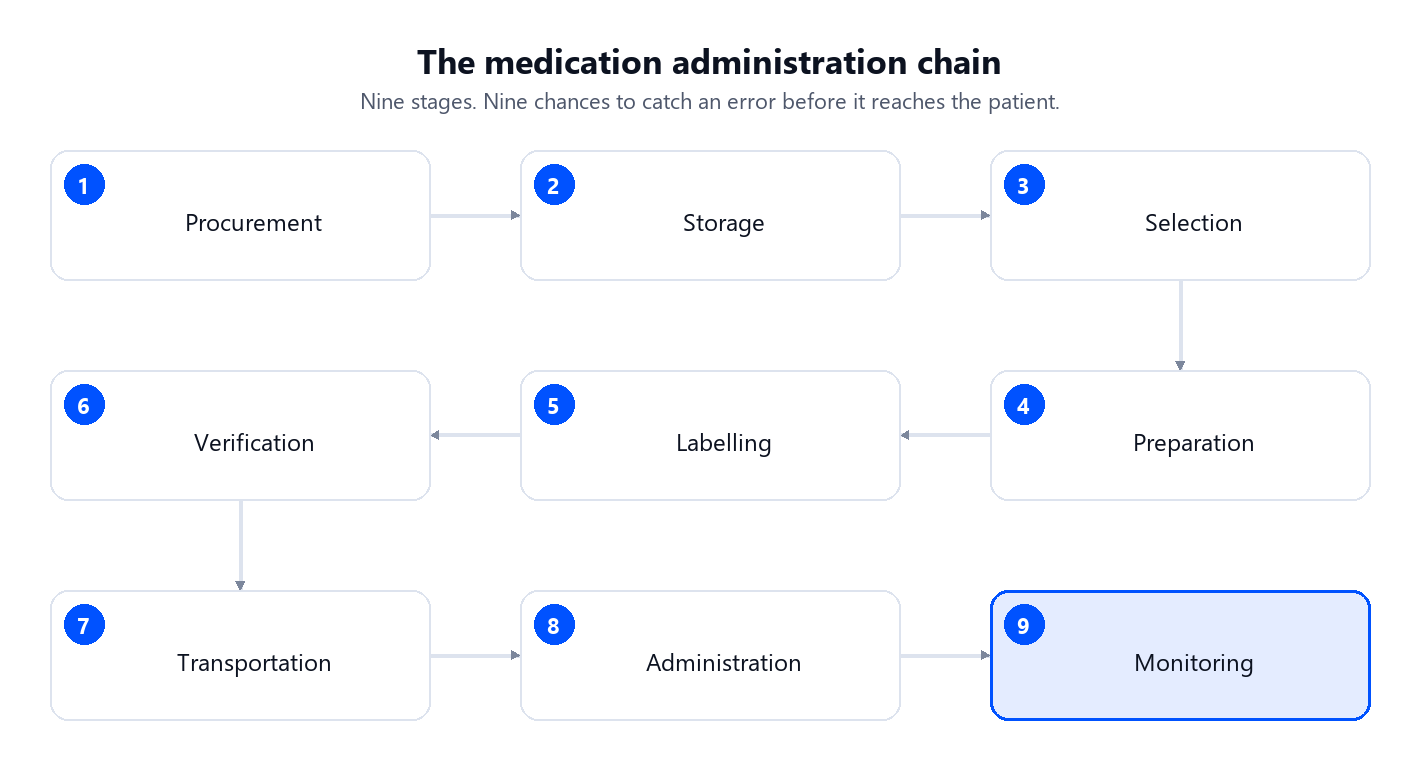
When a high-risk medication reaches a patient through several layers of the system, the question should not simply be: “Who made the mistake?” The more powerful patient-safety question is: “Why did our system allow the mistake to pass through every available safety barrier?” That distinction is fundamental to a mature safety culture.
The Swiss Cheese Model Comes Alive
James Reason’s Swiss Cheese Model of accident causation reminds us that serious harm generally occurs when multiple layers of defence develop holes that momentarily line up.
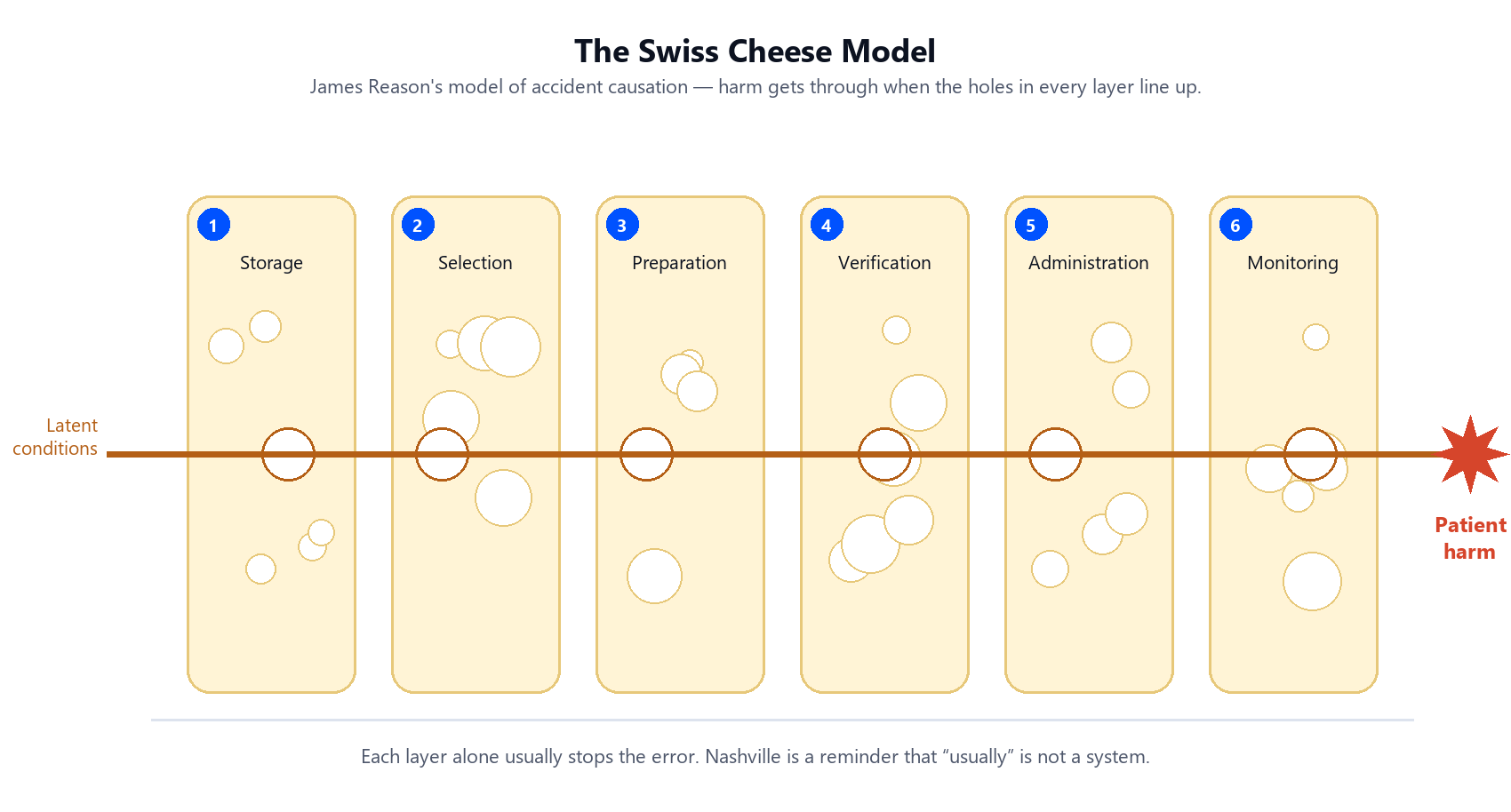
- Layer 1 Storage: Are high-alert medications physically segregated? Are look-alike/sound-alike medications separated? Are storage locations standardised?
- Layer 2 Selection: Could a person accidentally select the wrong medication? Is barcode verification available? Are electronic selection controls in place?
- Layer 3 Preparation: Was the medication prepared in a controlled environment? Was the preparation independently verified? Was the syringe or bag labelled immediately?
- Layer 4 Verification: Did another clinician verify the medication? Was there a meaningful independent double check, or simply a signature?
- Layer 5 Administration: Was the medication scanned? Was the route verified? Was the indication consistent with the medication? Would an electronic system have flagged an unusual medication-route combination?
- Layer 6 Monitoring: Could an abnormal physiological response have triggered an immediate escalation?
The critical insight is this: safety should not depend on one person getting everything right. Safety comes from designing systems in which one inevitable human error does not become patient harm.
The Signal Hidden in the Story: Repetition
Four patients being affected in the same event is particularly important. It suggests the possibility of a shared process failure somewhere upstream rather than four unrelated individual mistakes. That is precisely why healthcare organisations need to move beyond retrospective incident reporting.
An incident report tells us: “What happened?”
A mature digital QMS should help us understand: “Where are we vulnerable to this happening again?” And that is where prevention begins.
What If the Warning Signs Existed Before the Incident?
Imagine a hospital’s QMS could show that, over the preceding six months:
- High-alert medication storage audits were repeatedly overdue.
- Pharmacy medication errors were increasing.
- Several near-misses involved look-alike medications.
- Independent double-check compliance was falling.
- Barcode scanning compliance in one OT was below target.
- Similar medication-selection errors were occurring in different departments.
- CAPAs relating to pharmacy safety were repeatedly extended.
- Staff competency assessments were overdue.
- A particular medication had generated multiple Good Catch reports.
None of these events, individually, may trigger a sentinel event investigation. But together? They form a pattern. And that pattern is where prevention begins.
From Incident Management to Predictive Patient Safety
Most hospitals today have an incident management system. Staff report: Incident → investigation → RCA → CAPA → closure.
That is necessary. But it is not enough. A modern QMS should connect: Incidents + Near Misses + Audits + Risks + Complaints + Feedback + CAPA + Policies + Training + Competency + Performance Data.
Then ask: “What are these data telling us collectively?”
For example: 5 medication near misses + 2 failed pharmacy audits + declining barcode compliance + 3 overdue CAPAs + high-alert medication storage deviation should not remain five separate records.
They should become: EMERGING MEDICATION SAFETY RISK.
That is the difference between reporting safety and managing safety intelligently.

Leading Indicators Matter
Perhaps the most important lesson from Nashville is that hospitals need to measure leading indicators, not just outcomes. A hospital should not wait for: wrong medication → patient harm → incident report.
It should monitor:
- High-alert medication storage compliance
- Medication reconciliation compliance
- Barcode scanning compliance
- Independent double-check compliance
- High-risk medication audit scores
- Medication near-miss rate
- Good Catch frequency
- Look-alike/sound-alike medication incidents
- Medication competency compliance
- Pharmacy CAPA closure
- Repeat medication-related findings
- Medication error trends by department, shift and process
These are signals before catastrophe. The goal of quality management should be to identify the smoke before there is a fire.
What This Means for Hospital Leaders
Every hospital should ask five questions after seeing this incident:
- Where are our highest-risk medications? Do we know exactly where high-alert medications are stored, who handles them and where selection errors can occur?
- Where are our recurring near misses? Are we treating near misses as learning opportunities, or merely closing reports?
- Are our CAPAs actually reducing risk? A CAPA marked “closed” does not necessarily mean the risk has disappeared.
- Can our QMS detect patterns across departments? A pharmacy incident, an OT audit finding and a nursing competency gap may look unrelated when viewed separately. They may be connected.
- Can our leadership see emerging risk in real time? If the answer is “we’ll know during the next monthly quality meeting,” we may already be too late.
This Is Where Medblaze Can Make a Difference
At Medblaze, we believe a digital QMS should do much more than replace Excel sheets, registers and paper-based incident forms. It should become the early-warning system for quality and patient safety.
Medblaze can bring together data from Incident Management, Risk Management, Audit Management, CAPA, Patient Feedback, Infection Prevention, Competency, Performance Management and Accreditation Management into a connected quality ecosystem.
That enables hospitals to move from Reporting → Analysing → Understanding → Predicting → Preventing.
- Identify risks: Risk registers can be digitally maintained, scored, assigned and monitored, with ownership, mitigation plans and escalation.
- Identify patterns: Incident and near-miss data can be analysed across departments, medication categories, processes, shifts, locations and time to identify recurring patterns.
- Identify gaps: Audit findings, incidents, policy compliance, competency gaps and CAPA data can be connected to identify systemic weaknesses.
- Detect recurrence: When the same problem appears repeatedly, the system should not treat it as another isolated incident. It should recognise the repeat signal.
- Monitor leading indicators: Hospitals can build dashboards around preventive measures, not just adverse outcomes.
- Escalate emerging risks: When predefined thresholds or patterns are crossed, automated alerts and escalations can bring the issue to the attention of the right person before it becomes a major event.
- Close the learning loop: An incident should lead to learning. Learning should lead to corrective action. Corrective action should lead to measurement. And measurement should demonstrate whether the risk actually reduced.
The Future of Patient Safety Is Not More Forms
It is connected intelligence.
The Nashville incident is a tragic reminder that healthcare systems can have policies, trained professionals, accreditation and multiple safety checks, and still experience catastrophic failures.
The answer is not to blame individuals. The answer is to build stronger systems around people. Because humans will make mistakes. The question is whether our systems are designed to catch those mistakes before they reach the patient.
At Medblaze, that is the vision behind digital Quality Management:
“Don’t just record what went wrong. Connect the dots to understand why it happened, identify where the next failure could occur, and intervene before a patient is harmed.”
Patient safety should not begin with an incident report. It should begin with identifying risk early.
And perhaps the most important lesson from Nashville is this:
THE BEST MEDICATION ERROR IS THE ONE YOUR SYSTEM DETECTS BEFORE THE MEDICATION REACHES THE PATIENT.
Source note: this article reflects publicly reported information available at the time of writing. The Nashville incident remains under investigation; details may change as official findings emerge.