 Medblaze
A hospital can follow every clinical protocol at the bedside and still administer a counterfeit medicine, because the failure happened much earlier in the supply chain.
Imagine a patient receiving chemotherapy in a hospital that has followed every clinical protocol, completed every safety checklist and ensured that the treatment was prescribed by the right specialist. Yet, despite all these precautions, the medicine administered to the patient turns out to be counterfeit. The hospital may have done everything right at the bedside, but the failure occurred much earlier, somewhere within the medicine supply chain.
This is the uncomfortable patient-safety question raised by a recent investigation reported by The Indian Express. A Special Investigation Team of the Bengaluru Police and the Drugs Control Department reportedly uncovered a suspected counterfeit-medicine racket in which counterfeit cancer drugs, other life-saving medicines and ICU injections were allegedly supplied to more than 90 hospitals and clinics. Investigators also suspect that low-cost or expired medicines were repackaged and sold with counterfeit labels, with the alleged network extending beyond Karnataka.
These are allegations under investigation, and the facts must ultimately be established through the appropriate legal and regulatory processes. Nevertheless, the case raises a concern that extends far beyond the individuals or organisations involved. It challenges our assumptions about the integrity of medicines entering healthcare institutions and exposes the importance of ensuring that every medicine administered to a patient is genuine, traceable and safe.
For a patient receiving chemotherapy, a critical-care injection or another life-saving treatment, a medicine is not simply another item in hospital inventory. It is an essential component of clinical care, often administered when the patient is particularly vulnerable. A counterfeit product may contain the wrong ingredient, an incorrect concentration, no active ingredient at all, or potentially harmful substances. Even a product that looks identical to the genuine medicine may fail to deliver the expected therapeutic benefit.
The question is not merely, “who supplied the counterfeit medicine?” It is also, “how did a potentially counterfeit product travel through the healthcare supply chain and reach so many hospitals before it was detected?”
From reactive enforcement to proactive assurance
Criminal investigations, regulatory inspections, raids and prosecutions are essential to combating counterfeit medicines. Those responsible must be identified, and appropriate legal action must follow. However, enforcement that begins only after a suspected counterfeit product has entered the healthcare system is inherently reactive. A patient-safety system must also be capable of identifying vulnerabilities before they result in harm.
Hospitals should be able to establish the identity and provenance of medicines received into their premises. They should know who manufactured a product, which batch it belongs to, who supplied it, which distributors handled it and whether the product’s identity and packaging can be verified. If a batch is subsequently identified as suspicious, hospitals should be able to determine where it was received, whether it remains in stock, whether it has been dispensed or administered, and which other facilities may have received it.
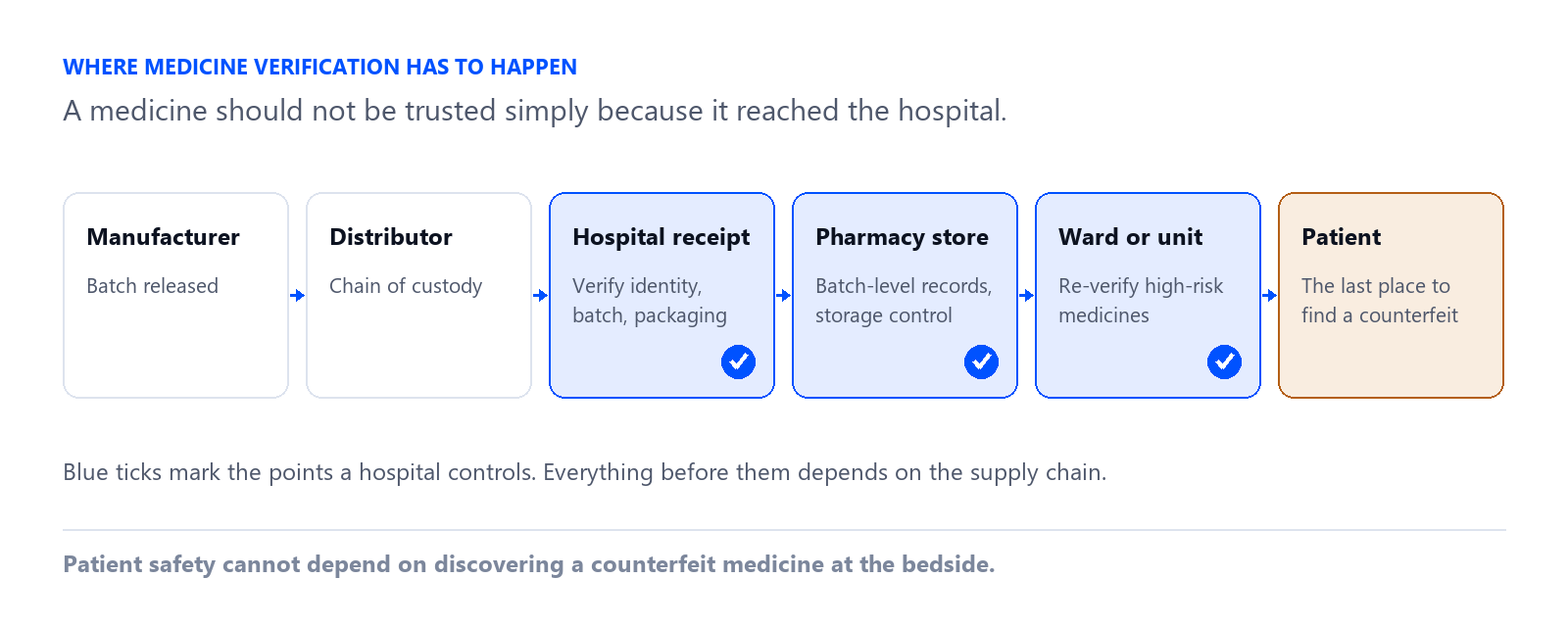
Without this visibility, responding to a suspected counterfeit product can become a time-consuming exercise involving invoices, purchase registers, telephone calls, emails and manual searches through pharmacy records. The delay can complicate containment, investigation and patient follow-up.
For high-risk medicines, traceability should therefore be treated as a patient-safety requirement rather than merely an inventory-management function.
International experience: building verification into the supply chain
The United States offers a useful reference through its Drug Supply Chain Security Act (DSCSA). The framework aims to establish an interoperable electronic system for identifying and tracing certain prescription drugs at the package level as they move through the pharmaceutical supply chain. It also includes mechanisms for handling suspect and illegitimate products, supporting verification and enabling appropriate investigation and response.
The European Union has taken a complementary approach through its falsified medicines framework. Safety features for many prescription medicines include a unique identifier carried in a two-dimensional barcode and an anti-tampering device. These features support verification and help detect potential falsification as medicines move through the supply chain and reach dispensing points.
The underlying principle is important: medicine authenticity should not depend entirely on the appearance of a package, the reputation of a supplier or the assumption that a product received through a legitimate-looking transaction must be genuine. Verification needs to be built into the processes through which medicines are received, stored, distributed and dispensed.
These international frameworks are not identical, and their requirements cannot simply be transplanted into India without considering the country’s regulatory environment, pharmaceutical distribution network, hospital infrastructure and implementation capacity. However, they demonstrate how technology and defined verification processes can strengthen supply-chain integrity.
India does not need to start from zero
India already has substantial pharmaceutical manufacturing capabilities, regulatory institutions and digital infrastructure. CDSCO has also published guidance concerning the identification and verification of medicines using barcodes or QR codes, including relevant product information such as manufacturer details, batch number, manufacturing date, expiry date and licence information.
The existence of a barcode or QR code, however, should not automatically be treated as conclusive proof that a medicine is genuine. A code can be copied, reproduced or placed on counterfeit packaging. Authentication becomes more meaningful when the identifier is connected to trusted product records and verification mechanisms, supported by controls that detect duplication, inconsistencies and suspicious supply-chain activity.
The challenge is therefore not simply to introduce more codes or labels. It is to create an interoperable system in which manufacturers, distributors, regulators, pharmacies and hospitals can verify relevant information and act on it.
What should India do next?
India should consider a risk-based national framework for medicine traceability, beginning with medicines where the consequences of a counterfeit product could be particularly serious. These could include selected cancer medicines, critical-care injections, biologics and other high-risk products, with the precise scope determined by regulators and clinical and pharmaceutical experts.
A digitally traceable medicine should have an identity that can be verified against trusted records. Its movement through the supply chain should be recorded at appropriate points, allowing authorised participants to establish where it originated, where it was transferred and which healthcare facilities received it.
Hospitals should be able to authenticate selected high-risk medicines when they are received into inventory and, where appropriate, verify them again before dispensing or administration. This would help prevent a medicine from being accepted merely because it arrived with an invoice or was supplied by a familiar distributor.
India should also strengthen the ability to identify all facilities that have received a suspect batch. When a product is flagged, the system should support rapid alerts, quarantine, recall, investigation and documented closure. Hospitals should be able to establish whether affected products remain in stock or have already been dispensed or administered, enabling appropriate clinical and regulatory follow-up.
A national framework should bring together CDSCO, State Drug Control authorities, pharmaceutical manufacturers, distributors, hospitals, pharmacies, technology providers and patient-safety experts. Clear responsibilities, data standards, verification procedures and reporting mechanisms would be essential to ensure that the system functions across organisational and geographical boundaries.
Pharmacovigilance: an important signal in detecting medicine-related risks
Medicine safety does not end when a product has been authenticated. Pharmacovigilance plays a critical role in identifying, assessing, understanding and preventing adverse effects and other medicine-related problems.
In hospitals, pharmacovigilance activities can help identify unexpected adverse drug reactions, unusual patterns of treatment failure, unexpected changes in a medicine’s effect and clusters of events that may warrant further investigation. For example, if several patients receiving the same medicine experience an unexpected lack of therapeutic response or an unusual adverse reaction, this may raise a safety signal that requires clinical assessment.
Such observations do not, by themselves, establish that a medicine is counterfeit. Treatment failure can have many explanations, including disease progression, patient-specific factors, administration errors, interactions, storage problems or other quality defects. Nevertheless, an unusual pattern should not be dismissed without appropriate investigation.
Hospitals should encourage healthcare professionals to report suspected adverse drug reactions and other relevant medicine-safety concerns through established pharmacovigilance processes. In India, the Pharmacovigilance Programme of India (PvPI) provides a national framework for adverse drug reaction monitoring and reporting.
It is equally important to recognise that suspected counterfeit or spurious medicines require appropriate quality-defect and regulatory reporting, not just an adverse drug reaction report. A suspicious product should be escalated through the hospital’s pharmacy and quality systems and reported to the relevant drug-control authority in accordance with applicable requirements. Where an adverse reaction has also occurred, the pharmacovigilance reporting process should be followed as well.
Pharmacovigilance and counterfeit-medicine surveillance therefore serve complementary purposes. One helps identify and evaluate medicine-related safety signals; the other supports investigation of product authenticity, quality and supply-chain integrity. Connecting these processes can help hospitals recognise patterns, investigate concerns and take timely action to protect patients.
The hospital’s responsibility: from procurement to the patient’s bedside
Although national regulation and pharmaceutical supply-chain controls are essential, hospitals also have an important responsibility to establish safeguards within their own operations.
The process begins with procurement. Hospitals should maintain appropriate supplier qualification and verification procedures, ensure that purchases are made through authorised channels and retain the documentation needed to establish the source of medicines. Procurement teams and pharmacy departments should have clear procedures for escalating concerns about suppliers, packaging, labelling, pricing anomalies or product documentation.
At the point of receipt, staff should verify relevant product details, including the medicine name, strength, batch number, expiry date, packaging condition and accompanying documentation. Additional checks should be applied to high-risk products in accordance with hospital policy and applicable regulatory requirements.
Storage and distribution controls are equally important. Hospitals should maintain appropriate storage conditions, restrict access to medicines, preserve batch-level records and ensure that products can be traced through internal pharmacy and clinical workflows. A hospital should be able to identify which departments or patients received a particular batch when such information is required for a safety investigation or recall.
If a medicine is suspected to be counterfeit, staff should know how to isolate the product, prevent further dispensing or administration, preserve relevant packaging and documentation, notify the appropriate personnel and initiate the required reporting and investigation processes. These responsibilities should be supported by training, clear escalation pathways and periodic audits.
How Medblaze QMS can support hospital medicine-safety processes
Digital quality management systems can help hospitals convert these expectations into structured, measurable and auditable workflows. Medblaze QMS can support this effort by providing a common platform for reporting concerns, managing investigations, conducting audits and tracking corrective and preventive actions.
Through the incident-management workflow, hospital staff can report a suspected counterfeit medicine, questionable packaging, a batch-related concern, an unexpected medicine-related event or a suspected breach in procurement and storage controls. Reports can be routed to the relevant pharmacy, quality, patient-safety or infection-control personnel, as appropriate to the nature of the event. Defined workflows, responsibilities, escalation rules and status tracking can help ensure that reports are reviewed and acted upon rather than remaining undocumented.
Medblaze can also support structured investigations by enabling teams to record the circumstances of an event, document available evidence, identify contributing factors, assign responsibilities and track corrective and preventive actions. Where a suspected counterfeit medicine has been identified, the investigation record can capture relevant details such as the product name, strength, manufacturer, batch number, supplier, date of receipt, departments involved and actions taken.
The audit-management capability can be used to develop and conduct audits of medicine procurement, supplier qualification, receipt verification, batch traceability, storage, dispensing, recall readiness and staff awareness. Findings can be documented, assigned to responsible departments and followed through to closure. Repeated findings or overdue actions can be escalated for management review, helping leadership identify weaknesses that require systemic improvement.
Where pharmacovigilance and medicine-quality reporting processes are established, Medblaze can support the hospital’s internal documentation, escalation and follow-up workflows. External reporting to the relevant authority or pharmacovigilance programme must still follow the applicable reporting requirements and designated channels.
The value of such a system is not simply that it digitises a paper form. It is that it can help establish accountability, improve visibility, support timely escalation and preserve the information needed for organisational learning. Digital quality workflows can strengthen hospital-level assurance, although they cannot independently authenticate a medicine unless they are connected to appropriate trusted verification and traceability systems.
The bigger question India must ask
The Bengaluru investigation should prompt healthcare leaders to examine how confidently they can establish the origin, authenticity and movement of medicines entering their institutions. It should also encourage hospitals to review whether their existing procurement, pharmacy, pharmacovigilance, incident-reporting and recall processes are sufficiently connected to identify and respond to emerging risks.
We should not assume that one investigation represents the entire scale of the counterfeit-medicine problem. Nor should we assume that every hospital receiving a suspicious product would necessarily have had the information or opportunity to detect it. These questions require evidence, investigation and a system-wide response.
What is clear is that medicine safety depends on more than the quality of the product at the manufacturing stage. It also depends on the integrity of the distribution network, the effectiveness of verification processes, the reliability of hospital controls and the ability to recognise and report concerns.
India has the pharmaceutical expertise, regulatory institutions and technological capabilities to strengthen these safeguards. The next step is to bring them together through practical, interoperable and risk-based systems that support verification, traceability, rapid response and accountability.
The medicine supply chain is not merely a logistics function. It is part of the patient-safety system. A medicine should not be trusted simply because it has reached a hospital.
The Bengaluru investigation should not be the end of a conversation about an alleged criminal network. It should be a catalyst for a broader national discussion on how India can strengthen medicine authentication, pharmacovigilance, hospital quality systems and supply-chain traceability.
Because patient safety cannot depend on discovering a counterfeit medicine after it reaches the bedside. It must be designed into the system before the medicine reaches the patient.
Practical hospital action checklist
Hospitals should translate medicine-safety policies into clearly assigned responsibilities, documented procedures and routine verification activities. The following checklist can be used by hospital leadership, pharmacy departments, procurement teams and quality managers to assess their readiness.
1. Procurement and supplier verification
- Purchase medicines only from appropriately licensed and approved suppliers.
- Verify supplier licences and credentials before onboarding and periodically thereafter.
- Maintain an updated list of approved manufacturers, distributors and suppliers.
- Investigate unusual pricing, unsolicited offers, unfamiliar intermediaries or unexplained changes in supply arrangements.
- Maintain purchase orders, invoices, delivery records and supplier details for every medicine consignment.
2. Medicine receipt and authentication
- Verify the medicine name, strength, dosage form, manufacturer, batch number and expiry date against the purchase order and delivery documentation.
- Inspect packaging, seals, labels and anti-tampering features for signs of damage, alteration, inconsistency or suspected tampering.
- Verify applicable barcodes, QR codes or other product identifiers using the appropriate trusted verification mechanism.
- Check for discrepancies in batch details, manufacturing information, labelling, packaging or product appearance.
- Escalate suspicious products to the pharmacy in-charge and designated quality or regulatory personnel before they are released for use.
3. Storage and internal distribution
- Maintain appropriate storage conditions in accordance with product requirements.
- Record and investigate temperature excursions and other storage deviations.
- Maintain batch-level inventory records that support identification of affected stock.
- Restrict access to medicine storage areas and maintain appropriate stock-handling controls.
- Ensure medicines transferred between pharmacy stores, wards and departments remain traceable.
4. Dispensing and administration
- Confirm that medicines released for dispensing have passed the hospital’s required receipt and verification checks.
- Apply additional verification procedures to designated high-risk medicines.
- Ensure that medicine name, strength, batch and expiry information can be retrieved when required for an investigation or recall.
- Train pharmacy and clinical staff to recognise suspicious packaging, unexpected product changes and potential medicine-quality concerns.
- Encourage staff to report suspected counterfeit products, unexpected treatment failures and other relevant medicine-safety signals promptly.
5. Suspected counterfeit medicine: immediate response
- Stop further dispensing or administration of the suspected product, where clinically and operationally appropriate.
- Quarantine the affected stock and clearly identify it as “do not use, under investigation”.
- Preserve the original packaging, labels, invoices, delivery records and other relevant evidence.
- Record the product name, strength, manufacturer, batch number, expiry date, supplier and date of receipt.
- Notify the pharmacy in-charge, hospital quality department, treating clinical team and other designated personnel.
- Escalate the matter to the relevant drug-control authority in accordance with applicable reporting requirements.
- Arrange appropriate clinical assessment and follow-up if patients may already have received the suspected product.
- Maintain a documented record of decisions, notifications, investigation findings and actions taken.
6. Pharmacovigilance and regulatory reporting
- Ensure that suspected adverse drug reactions are reported through the hospital’s established pharmacovigilance process.
- Report suspected counterfeit, spurious or otherwise defective medicines through the appropriate medicine-quality and regulatory reporting channels.
- Distinguish between an adverse drug reaction report and a report concerning suspected product falsification or quality defects.
- Review unusual clusters of treatment failure, unexpected adverse reactions or other medicine-related events for potential product-quality signals.
- Document the outcome of investigations and communicate relevant safety information to affected clinical teams.
7. Recall readiness and batch traceability
- Maintain records that identify the departments, wards or dispensing locations that received a particular batch.
- Test whether the hospital can rapidly identify all stock associated with a suspect batch.
- Establish a documented procedure for receiving, acknowledging and acting on medicine recalls and safety alerts.
- Ensure that affected stock can be quarantined promptly and that further dispensing or administration is prevented.
- Document the disposition of recalled or suspect stock in accordance with applicable requirements.
- Conduct periodic mock-recall exercises to evaluate the hospital’s ability to identify and contain affected products.
8. Quality audits and corrective actions
- Include medicine authenticity and supply-chain controls in the hospital’s internal audit programme.
- Audit supplier qualification, procurement documentation, receipt verification, storage, dispensing and batch traceability.
- Record audit findings, assign responsible personnel and establish corrective-action deadlines.
- Investigate repeated nonconformities and identify underlying process weaknesses.
- Verify the effectiveness of corrective and preventive actions before closing findings.
- Review medicine-safety incidents, audit trends and outstanding corrective actions during appropriate quality and management meetings.
9. Digital quality management
- Use incident-reporting workflows to document suspected counterfeit medicines and related quality concerns.
- Route reports to the designated pharmacy, quality and patient-safety personnel for assessment and action.
- Maintain investigation records, supporting evidence, assigned responsibilities and action status.
- Use audit workflows to assess compliance with medicine procurement, verification, storage and traceability procedures.
- Track corrective and preventive actions through to completion and document effectiveness reviews.
- Use incident and audit trends to identify recurring weaknesses and prioritise improvement initiatives.
- Ensure that any external regulatory or pharmacovigilance reporting required by law is completed through the appropriate channels. Internal documentation should support, not replace, those obligations.
10. Leadership review and accountability
- Assign clear responsibility for medicine authenticity and counterfeit-product response.
- Ensure staff receive periodic training on medicine verification, incident reporting and escalation procedures.
- Review medicine-quality incidents, audit findings, recall performance and corrective-action status at appropriate management forums.
- Identify gaps in digital traceability, supplier controls and verification capabilities.
- Establish measurable improvement actions and periodically reassess the hospital’s readiness.
The objective is straightforward: every hospital should be able to demonstrate that it has defined processes to verify medicines, identify suspicious products, contain potential risks, report concerns and learn from incidents.
For the legal and regulatory obligations that follow the discovery of a suspected counterfeit product, see our companion article on what a hospital must do when counterfeit medicines are discovered.
Talk to our team about medicine-safety workflows in Medblaze Infini →