 Medblaze
When a hospital identifies a suspected counterfeit medicine, its response must address patient safety, regulatory compliance, evidence preservation and organisational accountability.
The Drugs and Cosmetics Act, 1940, and the Drugs Rules, 1945, provide the central legal framework for medicines in India. Section 17-B defines spurious drugs, while provisions including Sections 18 and 27 address prohibited activities and penalties relating to drugs. The applicable obligations depend on the facts, the hospital’s role and the relevant legal provisions.
This article sets out practical compliance actions. It is not legal advice, and it should not be read as a claim that every action described is an identically worded statutory duty applicable to every hospital. Hospitals should obtain advice from their legal and regulatory teams when a suspected counterfeit product is identified.
1. Stop use, isolate the product and notify the appropriate authorities
The hospital should immediately prevent further dispensing or administration of the suspected product, subject to appropriate clinical arrangements for patients who depend on the medicine. Remaining stock should be segregated, clearly labelled and secured to prevent accidental use.
The pharmacy in-charge, hospital management and designated quality and patient-safety personnel should be notified without delay. The hospital should promptly contact the relevant State Drugs Control Department or Drugs Inspector and follow directions concerning sampling, testing, seizure, investigation and further handling of the product. Where criminal activity is suspected, the appropriate law-enforcement authorities should also be contacted in accordance with the circumstances and applicable requirements.
Hospitals should preserve the product, packaging, labels, invoices, purchase orders, delivery records and other relevant evidence. They should avoid destroying, returning or otherwise disposing of suspected counterfeit stock without appropriate regulatory guidance.
CDSCO publishes guidance concerning the identification and verification of spurious drugs, as well as information about regulatory action involving such products.
2. Identify every potentially affected patient
If the medicine has already been dispensed or administered, the hospital should initiate an urgent patient-exposure assessment. The assessment should establish:
- The medicine’s name, strength, dosage form, manufacturer and batch number.
- The quantity received, dispensed, administered, returned or remaining in stock.
- The dates on which the medicine was received and used.
- The departments, wards and clinical units that handled the product.
- The patients who may have received the affected medicine.
- The prescribed dose, actual dose administered, route and timing, wherever available.
- Whether the product has been used in combination with other medicines or as part of a critical treatment protocol.
The hospital should reconcile pharmacy inventory, dispensing records, medication administration records and relevant clinical documentation to establish the scope of exposure.
Where complete batch-level traceability is unavailable, the investigation should document this limitation and identify the broader group of patients who may potentially have been exposed.
3. Arrange clinical assessment and appropriate patient follow-up
A suspected counterfeit medicine does not automatically mean that every exposed patient has suffered harm. Equally, the absence of an immediate adverse reaction does not establish that the exposure was harmless.
The treating consultant and appropriate clinical specialists should assess each potentially exposed patient according to the medicine involved, the nature and duration of exposure, the patient’s clinical condition and the possible consequences of receiving a counterfeit, substandard or incorrectly formulated product.
For patients receiving chemotherapy, antibiotics, anticoagulants, insulin, critical-care medicines or other high-risk treatments, the clinical team should consider whether the exposure could have resulted in inadequate treatment, toxicity, treatment interruption or other complications.
Where necessary, the hospital should arrange clinical examination, laboratory investigations, additional monitoring or alternative treatment. Decisions about continuing, replacing or repeating treatment should be made by the treating clinician, taking account of the medicine involved and the patient’s condition.
Patients should not be advised to stop essential treatment without an appropriate clinical plan. Where treatment continuity is important, the hospital should arrange access to a verified alternative medicine as quickly as clinically appropriate.
4. Inform affected patients appropriately
Where patients may have received a suspected counterfeit medicine, the hospital should establish a timely and documented communication process.
Patients should receive information appropriate to the circumstances, including what is known about the product, what remains under investigation, whether they may have been exposed, what clinical assessment or follow-up is recommended and whom they should contact if they develop symptoms or have concerns.
Communication should be accurate, compassionate and understandable. Hospitals should avoid both minimising a potentially serious exposure and making unverified claims about the product or its consequences.
The hospital should document communication attempts, discussions, clinical advice and follow-up arrangements. If a patient cannot be contacted, reasonable further contact attempts and escalation should be recorded.
The precise disclosure obligations may depend on applicable law, professional standards, the patient’s circumstances and the nature of the incident. Hospital legal and clinical leadership should guide the process.
5. Report the incident through the appropriate channels
Hospitals should distinguish between several reporting pathways.
- Regulatory reporting. Suspected spurious or counterfeit medicines should be escalated to the relevant drug-control authority, with information and evidence provided in accordance with applicable requirements and regulatory directions.
- Pharmacovigilance reporting. Where a patient has experienced a suspected adverse drug reaction, the hospital should use the appropriate pharmacovigilance reporting process. The Pharmacovigilance Programme of India (PvPI) encourages healthcare professionals to report suspected adverse reactions. Its scope also recognises the importance of reporting medicine-related problems, including lack of efficacy and suspected pharmaceutical defects.
- Internal quality and patient-safety reporting. The hospital should record the incident in its internal quality management system, initiate an investigation and track corrective and preventive actions.
- Law-enforcement reporting. Where the facts indicate suspected criminal activity, the hospital should coordinate with the appropriate authorities and preserve relevant evidence.
An internal incident report does not replace a regulatory report or an adverse drug reaction report where either is required.
6. Investigate the supply chain and preserve evidence
The hospital should investigate how the suspected product entered its supply chain. This should include a review of supplier credentials, purchase documentation, invoices, delivery records, product verification, storage conditions and internal distribution.
The investigation should examine whether there were warning signs that were missed, whether established procedures were followed and whether weaknesses in procurement or pharmacy controls contributed to the incident.
The objective is to establish the facts, identify the source and scope of the problem, support the regulatory investigation and prevent recurrence. Findings should be evidence-based, with a clear distinction between confirmed facts, unresolved questions and allegations.
7. Manage recalls, corrective actions and governance review
Where a recall or other regulatory direction is issued, the hospital should follow the applicable instructions and ensure that affected stock is identified, quarantined and handled appropriately.
The hospital should also review whether its existing systems adequately support medicine authentication, batch traceability, supplier verification and rapid identification of exposed patients.
Corrective actions may include strengthening supplier qualification, revising procurement procedures, introducing additional verification checks, improving batch-level records, conducting staff training and implementing digital traceability or incident-management workflows.
The hospital’s governing body and appropriate committees should receive a documented review of the incident, including its clinical implications, regulatory response, investigation findings, corrective actions and outstanding risks.
What if the medicine has already been administered?
Consider a hospital that discovers that a batch of a suspected counterfeit injectable antibiotic was administered to patients over the preceding several days. The appropriate response is not simply to remove the remaining vials from the pharmacy.
The hospital should immediately stop further use of the affected batch, secure the remaining stock and notify the relevant internal leaders and regulatory authorities. Pharmacy and clinical teams should establish which patients received the medicine, when it was administered and whether any other facilities or departments may have received the same batch.
The treating clinicians should assess the potential consequences of exposure, including the possibility of inadequate antimicrobial treatment, unexpected toxicity or treatment failure. Patients should receive appropriate clinical follow-up and communication. Any suspected adverse reactions should be reported through the relevant pharmacovigilance process, while the suspected counterfeit product itself should be escalated through the appropriate regulatory channels.
The hospital should preserve evidence, cooperate with the investigation, document its decisions and ensure that corrective actions address the weaknesses identified.
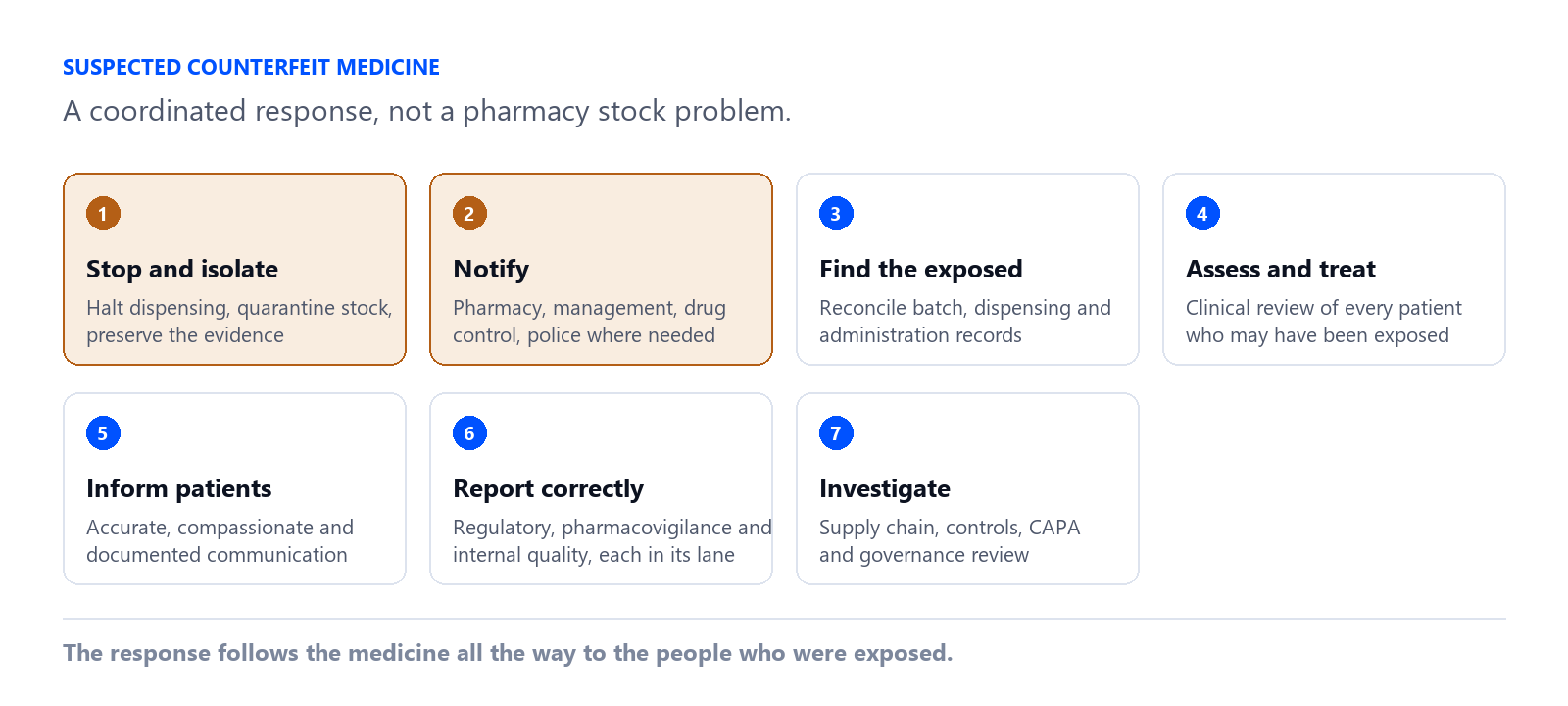
The discovery of a counterfeit medicine after administration is not merely a pharmacy stock problem. It is a patient-safety incident requiring coordinated clinical, regulatory, operational and quality-management action.
How Medblaze QMS can support the hospital’s response
Medblaze QMS can support the hospital’s internal response through structured incident reporting, investigation workflows, audit management and corrective and preventive action tracking.
A suspected counterfeit medicine can be recorded as a medicine-quality or patient-safety incident, with relevant product details, batch information, supplier records, departments involved and known patient exposures documented in the investigation.
The hospital can assign responsibilities to pharmacy, clinical, quality and management personnel, establish escalation workflows and track actions such as stock quarantine, patient identification, clinical follow-up, regulatory communication and investigation closure.
Audit-management workflows can also be used to evaluate supplier qualification, receipt verification, medicine storage, batch traceability and recall readiness. Repeated findings can be reviewed to identify systemic weaknesses and prioritise improvement initiatives.
These capabilities support internal governance and accountability. They do not replace statutory reporting, clinical judgement, regulatory investigation or the need for a trusted medicine-authentication mechanism.
The ultimate objective is to ensure that a suspected counterfeit medicine triggers a coordinated response: protect patients, contain the risk, report the concern, establish the facts and prevent recurrence.
A hospital’s responsibility does not end when a medicine is removed from its shelves. When patients may already have received it, the response must follow the medicine all the way to the people who were exposed, and continue until the clinical, regulatory and quality-management actions have been appropriately addressed.
For the wider picture of why medicine traceability matters, see our companion article on why medicine traceability must become a patient-safety priority in India.