 Medblaze

Quality professionals enter the field to make care safer. So why does the work so often end up feeling like another audit, another tracker, another form?
There is a strange paradox in healthcare quality management.
Quality professionals enter the field because they want to make healthcare safer, better and more reliable. They want to prevent harm, improve systems, strengthen patient experience and help healthcare teams perform at their best.
And yet, somewhere along the way, the work can start feeling repetitive. Another audit. Another checklist. Another corrective action plan. Another root cause analysis. Another document review. Another training session. Another compliance tracker. Another accreditation preparation meeting.
The irony is that the people responsible for making healthcare better can themselves become tired of the way “quality” is being managed. This is not necessarily a problem of people lacking commitment. It may be a problem of how we have designed quality management itself.
When quality becomes synonymous with compliance, the work can slowly shift from “how can we make care better?” to “can we prove that we did what the standard says?” Compliance is necessary. But compliance alone is rarely inspiring.
When quality becomes a checklist
Standards, policies, audits, indicators, incident reports, RCA, CAPA, training records and accreditation requirements are essential components of a mature healthcare quality system. The problem begins when these tools become the destination rather than the means.
A quality manager may spend hours checking whether a form has been completed, whether a training record has been signed, whether a policy has been reviewed or whether an audit score has crossed a predetermined threshold.
Over time, the professional identity can subtly change. Instead of being an improvement architect, the quality professional becomes a compliance monitor. Instead of asking, “what can we learn from this?”, the organisation asks, “why is this not compliant?” Instead of celebrating a near miss because someone identified a weakness before it harmed a patient, teams may become anxious about reporting it because they fear another number appearing on the dashboard.
That is when quality starts becoming administrative rather than transformational. And administrative work, particularly repetitive administrative work with limited autonomy or visible impact, can become psychologically draining.
A 2024 systematic review examining audit and feedback found that although nurses can see audit as an opportunity for professional development, poorly framed or delivered audit processes can also contribute to stress, burnout and workplace demotivation. The authors concluded that the framing, delivery and content of audit and feedback matter significantly.
The lesson extends beyond nursing. Quality professionals are not machines designed to process checklists. They are problem solvers, investigators, educators, system designers and storytellers. Increasingly, they should also be data-driven change leaders.
The psychological cost of “doing quality”
There is another dimension that healthcare organisations should pay attention to: the relationship between quality work and professional wellbeing.
Repetitive work is not automatically bad. Routine creates reliability. But routine without meaning can become monotonous.
Imagine spending five years identifying the same gaps, conducting the same audits and presenting the same observations, without having the authority, resources or organisational support to fundamentally change the underlying system. The professional begins to experience a frustrating cycle: find the problem, report the problem, recommend action, follow up, find the same problem again.
Eventually, the question becomes: what difference am I actually making?
That question is dangerous, not because it indicates poor commitment, but because it signals a loss of connection between effort and impact.
And when that happens, work-life balance can suffer too. A professional who feels that the work is never “finished” may carry unresolved CAPAs, pending audits, accreditation requirements and performance indicators mentally beyond working hours. The result can be a peculiar form of exhaustion: being busy without feeling accomplished.
Quality leaders therefore need to think about employee engagement and wellbeing not as HR issues sitting outside quality management, but as part of the infrastructure required for sustainable quality improvement.
And there is a patient safety consequence
This is where the conversation becomes much more important. A disengaged quality professional does not simply have a less enjoyable workday. The organisation may gradually lose curiosity. And curiosity is fundamental to patient safety.
A highly engaged quality professional sees a small variation and asks: why did this happen? A disengaged professional sees the same variation and asks: is this within the acceptable limit?
Those are very different questions. One seeks understanding. The other seeks closure. The first can uncover latent system weaknesses. The second can merely document compliance.
Patient safety depends on people being willing to notice weak signals, question assumptions, report near misses, challenge unsafe processes and continuously learn from everyday work. That is why the quality function must move beyond finding failures to creating learning systems.
Research from Epworth HealthCare Richmond, a 600-bed hospital in Melbourne, explored a team-based approach called map-enabled experiential review. Instead of waiting for an adverse event and then investigating it, frontline staff regularly discussed how routine clinical work actually happened. The objective was to bring frontline knowledge into quality improvement and strengthen engagement with safety activities.
That is an important shift. Quality does not have to begin with something going wrong. Sometimes quality begins with asking what is happening here every day, and what could we make better.
What if quality managers became game designers?
Perhaps one way to make quality more exciting is to borrow an idea from an unlikely place: the world of games.
Gamification does not mean turning patient safety into entertainment. It means introducing elements such as challenge, progress, feedback, recognition, competition, achievement and discovery into activities that people normally perceive as routine.
And there is evidence that this can work in healthcare. At UCSF Benioff Children’s Hospital, researchers implemented a digital intervention combining microlearning, self-assessment and social gamification to improve central-line infection prevention. Nurses participated in inter-unit competitions. Over the 12-month intervention, the CLABSI rate in participating units fell by 48% compared with the preceding year, while engagement with the self-assessment increased.
The point is not that every quality problem needs a leaderboard. The point is that engagement can be designed.
Imagine transforming the monthly infection-control training from a 45-minute slide presentation into a “Zero Harm Challenge”. Teams receive five real-world scenarios: one involving hand hygiene, one PPE, one environmental cleaning, one an isolation precaution and one a near miss. The team has to identify the risk, explain what should happen, find the system weakness and propose an intervention.
Suddenly, training becomes problem solving.
The same principle can be applied to audits. Instead of announcing, “the quality team will conduct the monthly nursing audit”, announce: “can your unit find five hidden patient-safety risks before the quality team does?”
Now the audit becomes a challenge. And when frontline teams start looking for risks themselves, the quality department moves from being the policing function to becoming the coach.
Turn RCA into a mystery
Root cause analysis is another area where quality professionals can inject energy. RCA can become mechanical when teams simply fill in a template: incident description, five whys, fishbone diagram, root cause, corrective action.
But imagine approaching it as a detective exercise. Present the team with an anonymised case. A medication reached the wrong patient. The obvious explanation is human error.
Then reveal additional clues. The medication trolley was overcrowded. The two patients had similar names. The barcode scanner was unavailable. The nurse was interrupted twice. The medication labels were difficult to distinguish. The staffing level was lower than usual.
Suddenly the question changes from “who made the error?” to “what conditions made the error more likely?” That is not only more interesting. It is also closer to the philosophy of modern patient safety.
Quality professionals can turn RCA into Safety Detective, Find the Failure, Five Whys Challenge or Design Out the Risk sessions. The winning team is not the team that identifies the person who made the mistake. It is the team that identifies the strongest system intervention.
Make near-miss reporting a game
Near misses are another opportunity. Instead of measuring departments only on the number of incidents they report, organisations can create recognition around learning behaviour.
Consider a Best Catch of the Month. A nurse notices that two look-alike medications have been stored next to each other. A pharmacist identifies a prescribing ambiguity before dispensing. A technician notices a defect in a medical device. A housekeeping supervisor identifies a recurring environmental hazard.
These can become “good catches”. The organisation can recognise the individual or team, not because they prevented a bad score, but because they prevented potential harm.
This sends a powerful cultural message: we reward people for finding vulnerabilities before patients are harmed. That is a very different quality culture from one where incident reporting is perceived as creating trouble.
Quality scoreboards can be more than KPI dashboards
Most hospitals already have performance dashboards. But many dashboards are designed for monitoring rather than motivation. A quality dashboard can become a performance gameboard.
Imagine a unit-level patient safety scorecard displaying progress on incident reporting, near-miss reporting, hand hygiene, medication safety, audit closure, patient complaints, response time, staff training, patient experience and improvement projects.
But rather than simply displaying red, amber and green indicators, allow teams to accumulate points for improvement. A department that improves hand hygiene from 72% to 88% earns recognition. A unit that closes a recurring CAPA earns points. A department that submits a high-quality near-miss report earns a badge. A team that completes a successful PDSA cycle earns recognition.
The objective should not be to create unhealthy competition. It should be to create visible progress. People are motivated when they can see that they are moving forward.
Five games every quality manager could try
The possibilities are surprisingly simple.
- Safety Bingo can contain common risks such as missing patient identification, incomplete consent, unsecured medication, inappropriate PPE or documentation gaps. Staff mark a square whenever they identify and correct one during routine work.
- Quality Jeopardy can turn policies, accreditation standards and patient-safety concepts into short team-based quizzes.
- Spot the Risk can use a photograph of a patient-care environment containing deliberately embedded safety hazards. Teams compete to identify as many as possible.
- RCA Escape Room can give teams a sequence of clues relating to an adverse event. Solving each clue reveals the next piece of the system failure.
- The Quality Scavenger Hunt can ask teams to locate evidence of safe practice across their own department: emergency equipment, identification processes, escalation mechanisms, infection-control practices and documentation.
None of these requires expensive technology. The most important ingredient is good design.
Gamification should not become another KPI burden
There is an important warning here. If gamification is poorly designed, it can create exactly the problem it is intended to solve.
If staff are constantly ranked, publicly compared or penalised, competition can become stressful. If departments are rewarded simply for having fewer reported incidents, reporting can actually decrease. If employees receive points for completing activities rather than improving outcomes, the organisation may simply create another compliance exercise.
Gamification should therefore reward learning, improvement, collaboration and problem solving, not superficial activity. The objective is not “who completed the most checklists?” It is “who helped the organisation become safer?”
Give quality professionals a performance system too
Quality managers themselves need a performance-management system that goes beyond the number of audits completed. Consider measuring four dimensions.
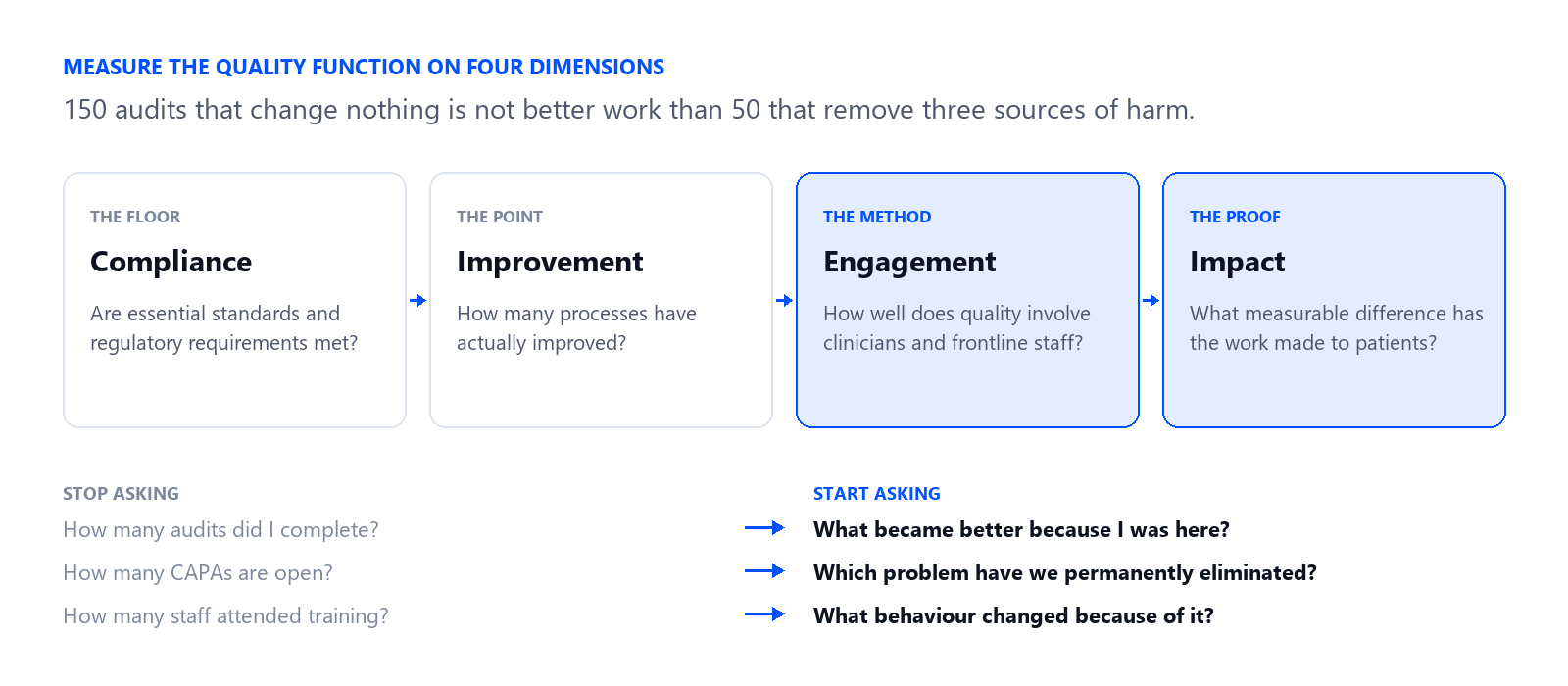
- Compliance: are essential standards and regulatory requirements being met?
- Improvement: how many meaningful processes have actually improved?
- Engagement: how effectively is the quality team involving clinicians and frontline staff?
- Impact: what measurable difference has the work made to patient safety, patient experience, efficiency or clinical outcomes?
A quality manager who conducts 150 audits but changes nothing should not necessarily be considered more effective than someone who conducts 50 audits and eliminates three recurring sources of harm.
This is where tools such as PDSA cycles, A3 problem solving, Lean improvement boards, balanced scorecards, SMART objectives, competency matrices and visual management boards can become useful, not as additional bureaucracy, but as mechanisms for showing progress and creating ownership.
Digital quality management systems can take this further by turning static compliance data into dynamic quality intelligence. Instead of asking a quality manager to manually consolidate hundreds of spreadsheets, audit reports, incidents, CAPAs and training records, a digital QMS can bring these signals together, automate reminders and escalations, identify recurring trends and give leaders real-time visibility.
The quality professional can then spend less time collecting data and more time interpreting it and improving systems. That is arguably one of the most important promises of a modern healthcare QMS.
What hospitals are already learning
The idea is not theoretical.
The Campus Bio-Medico University Hospital Foundation in Rome created a “Campus Game” to improve knowledge of quality and clinical risk management. The programme used badges, quizzes, teams and leaderboards. In its 2021 edition, 178 people participated, and the hospital reported increased access to its quality and patient safety information and to hospital policies and procedures. The initiative also incorporated annual quality awards and recognition for incident reporting.
A later 2022 version involved 18 teams and 145 participants, using digital quizzes, feedback, rewards and badge challenges covering topics such as hand hygiene, emergency evacuation and data protection.
More recently, a 2025 hospital infection-prevention study involving 105 healthcare workers found that gamification increased engagement with infection-prevention education and was associated with a 170% increase in mean alcohol-based hand-sanitiser consumption between baseline and the final intervention phase.
There is also evidence that interactive approaches can influence broader safety culture. A study of customised hospital safety interventions incorporated workshops, educational activities, game booths and team-building exercises, with an emphasis on management recognition and frontline empowerment.
And perhaps most importantly, research on quality-improvement collaboratives in NHS hospitals found that motivation was strengthened by local champions, shared learning and opportunities for practitioners to participate in improvement, not simply by imposing another programme from above.
The common thread is simple: people engage more deeply when they are participants in improvement rather than recipients of compliance instructions.
How can a quality manager motivate themselves?
The first step may be to change the question.
- Instead of “how many audits did I complete this month?”, ask: what became better because I was here?
- Instead of “how many CAPAs are open?”, ask: which recurring problem have we permanently eliminated?
- Instead of “how many staff attended training?”, ask: what behaviour changed because of the training?
- Instead of “did the department pass the audit?”, ask: did the department become safer because of the audit?
That shift, from activity to impact, can radically change how the job feels.
A quality professional should deliberately spend time every week doing something different from routine compliance. Visit a clinical area without an audit checklist. Talk to a patient. Ask a nurse what frustrates her about a process. Shadow a porter. Observe how medication actually moves through the hospital. Sit with housekeeping. Study one unusual incident. Look for a process nobody has complained about yet. Read one new patient-safety study. Try one new improvement method.
These activities restore something that quality management can easily lose: curiosity.
And how can leaders motivate quality teams?
Perhaps the most important thing leaders can do is stop celebrating activity and start celebrating impact.
Celebrate the person who discovered a latent safety risk. Celebrate the team that simplified a complicated process. Celebrate the nurse who reported a near miss. Celebrate the quality manager who eliminated a recurring CAPA. Celebrate the department that improved a patient experience metric. Celebrate the frontline employee who challenged an unsafe practice.
And tell the story, because stories create meaning.
A dashboard might say that medication errors declined by 18%. A story says: a nurse noticed that two high-alert medications were stored beside each other, the team redesigned the storage system, introduced a visual distinction and prevented the next error.
The second is what people remember.
The future of quality management is not more checklists
Healthcare will always need standards. We will always need audits. We will always need RCA. We will always need policies, indicators, training and accreditation.
The answer is not to eliminate compliance. The answer is to make compliance the foundation, not the ceiling.
The next generation of healthcare quality management needs to combine compliance with curiosity, data with storytelling, technology with human judgement, and accountability with psychological safety. It needs quality professionals who are not merely asking whether the hospital meets the standard, but whether the standard is helping the hospital deliver safer and better care. It needs digital QMS platforms that reduce administrative burden and turn fragmented information into actionable quality intelligence.
And it needs leaders who understand that motivation is not a soft concept sitting outside patient safety. Motivation is part of the safety system.
When quality professionals are engaged, they ask better questions. When frontline teams are engaged, they report more, learn more and improve more. When leaders are engaged, improvement gets resources and attention. And when all three work together, quality stops feeling like an endless cycle of audits and CAPAs. It becomes what it was always meant to be: the continuous pursuit of better care.
Perhaps the next question every Chief Quality Officer should ask their team is not “how can we improve our compliance?” but “how can we make quality exciting enough that people want to improve?”
That may be where the next generation of patient safety begins.
See how Medblaze Infini turns compliance data into quality intelligence →