 Medblaze
52 Lakh Medical Injuries a Year: Will Your Hospital Prevent the Next One?
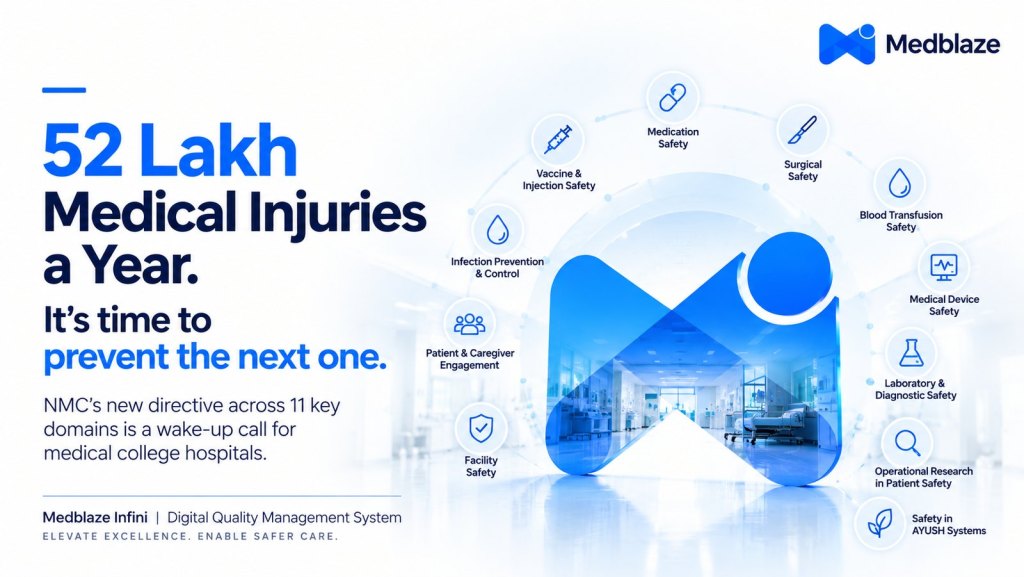
The NMC initiative asks medical colleges to organise patient safety across 11 domains. This paper sets out those domains, the structural reasons teaching hospitals find safety hard to sustain, the move from NPSIF 2018-2025 towards NAPPS 2030, and what it takes to turn safety activity into measurable improvement.
01Executive summary
What happens in your hospital when a patient develops a healthcare-associated infection, a medication error goes unreported, a critical laboratory result is not escalated, or a near miss occurs during a busy night shift? Does the institution investigate, find the underlying causes, act and verify that the risk has fallen? Or does the event stay in a departmental register, get mentioned at a meeting and fade?
A recent report by Deccan Herald, titled “NMC mandates patient safety committees in 11 key domains to curb 52 lakh medical injuries”, describes the National Medical Commission’s initiative to strengthen patient safety across medical colleges and medical institutions. The report cites an estimate of 52 lakh (5.2 million) injuries a year associated with medical errors, including medication errors and hospital-acquired infections.
For medical college hospitals the implications are significant. These institutions sit at the intersection of patient care, undergraduate and postgraduate education, clinical research and public health. They manage complex cases, high volumes, many specialties and a constantly changing mix of students, residents, faculty and nursing staff.
This paper sets out the 11 domains the directive covers, the structural reasons medical college hospitals find safety hard to sustain, how the national policy picture is moving from NPSIF 2018–2025 towards the proposed NAPPS 2030, and what an institution needs in place to turn safety activity into measurable improvement.
02The 11 patient safety domains
The reporting on the NMC directive identifies 11 domains spanning clinical care, diagnostics, infection prevention, patient engagement and hospital operations. Taken together they describe a whole-hospital approach rather than a clinical-only one.
Each domain needs the same underlying machinery: a way to report what happened, a way to classify and investigate it, an owner for the resulting action, and evidence that the action worked. A committee for each domain without that machinery produces meetings rather than improvement.
03Why medical colleges are different
Medical college hospitals are not simply larger versions of other hospitals. Their academic structure, workforce rotation and teaching responsibilities create distinctive challenges, and those challenges are structural rather than a matter of individual competence.
1. Rotating residents, interns and clinical teams
A resident may raise a safety concern during one rotation while the investigation and corrective action continue after they have moved on. Without structured handover and central tracking, the learning is lost.
Standardised induction and competency assessment, accessible protocols, structured handovers, and a central record of incidents and actions that outlives any individual rotation.
2. A learning environment that discourages reporting
Students and junior doctors may hesitate to report errors or near misses if they fear blame, poor evaluations or reputational harm. Those are precisely the events an institution can learn from before serious harm occurs.
Accessible reporting, confidential options where appropriate, non-punitive learning processes, and visible leadership support for people who speak up.
3. High volumes and complex clinical pathways
Patients move between emergency, intensive care, theatres, laboratories and several specialty teams. Every transition is an opportunity for a communication failure, delay, omission or duplication.
Clear escalation pathways, standardised workflows, monitoring of critical processes, and the ability to see patterns across departments rather than one incident at a time.
4. Fragmented data and competing academic priorities
Safety information sits in incident registers, pharmacy records, laboratory systems, infection control spreadsheets, audit reports and meeting minutes. Quality teams spend their time collecting data rather than analysing it.
Connected digital quality management that makes safety information accessible, actionable and quick to review.
5. Corrective actions that do not survive staff transitions
A committee recommends a change to medication administration, infection prevention or the surgical checklist. Implementation weakens when staff rotate, leadership changes or actions are not reviewed consistently.
Named action owners, target dates, escalation when actions slip, documented handovers, and verification that the intervention actually improved safety.
Read together, these five pressures explain why safety initiatives in teaching hospitals often start well and then decay. The people change faster than the systems do, so the systems have to carry the memory.
04From NPSIF 2018 to NAPPS 2030
India’s patient safety agenda predates this directive. The Ministry of Health and Family Welfare introduced the National Patient Safety Implementation Framework (NPSIF) 2018–2025, building on work initiated in 2017, covering public and private facilities across prevention, diagnosis, treatment and follow-up.
The framework set six strategic objectives, all of which remain relevant to medical colleges because they connect institutional practice with workforce development, surveillance, improvement and research.
- Strengthen structures and systems that support quality and patient safety.
- Assess the nature and scale of adverse events, and establish systems for reporting and learning.
- Develop a competent workforce that understands and prioritises patient safety.
- Prevent and control healthcare-associated infections.
- Implement global patient safety campaigns and strengthen safety across health programmes.
- Build capacity for, and promote, patient safety research.
What comes next
In September 2026 the Ministry of Health and Family Welfare reported that the National Action Plan for Patient Safety (NAPPS) 2030 was being developed through the National Patient Safety Secretariat. The proposed plan builds on NPSIF and covers medication, surgical, blood, medical device, laboratory and diagnostic, infection, vaccine and injection, facility and AYUSH safety, alongside operational research and patient, family and caregiver engagement.
The same update highlighted the India Patient Safety Network, which brings together AIIMS institutions and other Institutes of National Importance to support knowledge sharing, peer learning and evidence-based improvement.
For medical college hospitals the direction is consistent: safety has to be embedded in institutional systems, supported by measurable indicators, capable teams, evidence generation and continuous learning.
05From places of care to engines of evidence
Medical colleges have an opportunity most healthcare organisations do not: they can connect daily clinical practice with structured research, education and policy. Every incident, near miss, audit finding and improvement initiative can generate learning when the information is collected systematically and analysed responsibly.
1. Turn incidents into research questions
Consider a teaching hospital seeing recurring medication administration errors around shift changes. Instead of treating each as an isolated event, the institution can ask:
- Which departments report the most, and why?
- Are errors more common at particular transitions or workloads?
- Do new residents and interns need additional orientation?
- Does a structured handover intervention reduce errors?
- Are the improvements sustained after the next rotation?
The answers can inform a quality improvement project, a postgraduate dissertation or a peer-reviewed publication. The same approach applies to surgical checklist compliance, specimen rejection, critical-result communication, healthcare-associated infections, sharps injuries and delays in corrective action.
2. Evaluate whether interventions actually work
Hospitals frequently introduce training, checklists, revised SOPs and awareness campaigns. Implementing an intervention does not establish that it worked. Baseline measurement, a defined intervention and follow-up audit can show whether practice improved and whether the change held. Where appropriate, stronger study designs help separate genuine improvement from changes in case mix or reporting behaviour.
3. Build patient safety into medical education
Safety should not stay inside the quality department. Students, interns, residents, nursing students and allied health professionals should learn to identify hazards, report incidents, communicate risk, take part in root cause analysis and run improvement projects, through clinical postings, simulation, academic discussion, mortality and morbidity meetings and competency-based training.
4. Build institutional safety registries
A structured repository of classified incidents, near misses, infection events, medication errors and interventions supports trend analysis and research. Over time an institution can compare departments, identify recurring patterns and contribute anonymised, aggregated insight to wider collaborations. This work must respect ethics review, privacy, consent and data governance requirements, and sharing across institutions needs suitable governance.
5. Contribute to national goals
India’s patient safety agenda needs more than directives. It needs evidence about what works, in which settings, for which patients and at what cost. Medical colleges can generate locally relevant evidence, test interventions, document what succeeded and share results through academic networks and national initiatives.
06Why digital quality management is the enabler
Turning this into practice requires reliable data and repeatable processes. Paper registers and disconnected spreadsheets capture individual events, but they make it hard to connect an incident report with the risk assessment, the audit finding, the training need, the corrective action and the outcome.
A digital Quality Management Information System provides the common operational framework. An effective one helps a medical college hospital:
Digital systems depend on sound definitions, reliable data entry, appropriate access controls and a culture that encourages reporting. Technology alone cannot create patient safety. It can make safety processes more consistent, visible and measurable.
07How Medblaze Infini can help
Medblaze Infini, the digital Quality Management Information System from Medblaze, helps healthcare organisations streamline quality management, patient safety, accreditation and compliance. For medical colleges implementing the NMC framework, it can support the move from fragmented manual processes to a connected digital quality ecosystem.
Incident management and learning
Digitised incident and near-miss reporting helps staff document safety concerns and supports structured investigation. Trend analysis helps quality teams identify recurring events and prioritise where to intervene.
Risk management and corrective action
Risk assessments, root cause analysis workflows and CAPA tracking help institutions assign responsibility, monitor deadlines, escalate overdue actions and verify whether corrective measures were effective.
Infection surveillance and prevention
Digital surveillance supports monitoring of healthcare-associated infections and related indicators, helping teams review patterns and investigate emerging concerns.
Audit and document management
Audit workflows help conduct safety audits, track non-conformities and monitor compliance with institutional policies and SOPs, while document management keeps current protocols controlled and accessible.
Dashboards and performance monitoring
Consolidated dashboards give leadership visibility into incidents, audit findings, unresolved actions and selected safety indicators, supporting more focused departmental reviews.
Supporting research and improvement
Structured quality data helps institutions identify research questions, monitor interventions and evaluate improvement over time. Subject to data governance, ethics approval and research protocols, it can support improvement studies and academic research.
Medblaze does not replace the expertise of clinicians, the oversight of patient safety leaders or the academic responsibilities of a medical college. It provides the workflows and visibility that help those people work more systematically.
08Making safety measurable
The NMC initiative arrives at an important moment. The move from NPSIF 2018–2025 towards the proposed NAPPS 2030 reinforces patient safety as a sustained institutional priority rather than a periodic exercise.
For medical college hospitals the task is especially consequential. Rotating teams, complex pathways, fragmented data and competing academic demands make safety initiatives hard to sustain. Yet these same institutions hold the clinical expertise, research capability and educational infrastructure to generate evidence that improves patient safety nationally.
The way forward is to connect governance with execution, incident reporting with learning, corrective action with verification, and institutional data with meaningful research.
See how Medblaze Infini supports incident management, CAPA and infection surveillance →
ASources and further reading
- Deccan Herald: “NMC mandates patient safety committees in 11 key domains to curb 52 lakh medical injuries”.
- National Medical Commission: the official notice and terms of reference for patient safety committees.
- Ministry of Health and Family Welfare: National Patient Safety Implementation Framework 2018–2025, available through the National Health Systems Resource Centre.
- Ministry of Health and Family Welfare: update on national patient safety initiatives, September 2026, including the proposed National Action Plan for Patient Safety 2030 and the India Patient Safety Network.
This paper summarises publicly reported information for educational purposes. It is not legal or regulatory advice. Institutions should verify requirements against the official NMC notice and applicable regulations.
See this run against your own standard
A working session with your quality team: your target tier, your accreditation framework, your HIS. We map your gap live, not from a slide deck.
